
Certified vs Non-Certified Rudraksha: What Really Matters? (Complete 2026 Guide)
Everything you need to know about Rudraksha certification — which labs matter (IGL, GTL, GJEPC), what the certificate actually proves, red flags in fake certificates, and whether you need one for every bead.
Quick Answer: For any Rudraksha priced above ₹500, an independent lab certificate (IGL, GTL or GJEPC) is essential. The certificate verifies natural origin, exact mukhi count via X-ray, size, weight and origin. "In-house certificates" from the seller themselves are worthless. For beads below ₹500 (small Indonesian), certification is optional but a written return policy is a must.
The Indian Rudraksha market crosses ₹1,200 crore annually — and by conservative estimates, 65-75% of beads sold online are fake, mislabelled, or misgraded. The single most effective defence against buying a fake bead is a genuine independent lab certificate. Yet most buyers have no idea what a real certificate looks like, or how to verify one.
This guide breaks down everything about Rudraksha certification — which labs matter, what tests they perform, how to verify a certificate, and the red flags that expose fake certificates instantly.
What Does Certification Actually Verify?
A proper Rudraksha lab certificate scientifically confirms five things:
1. Natural origin — the bead is a genuine *Elaeocarpus ganitrus* seed, not carved wood, resin or a look-alike species
2. Exact mukhi count — verified by X-ray showing internal seed compartments matching external mukhi lines (this is why glued fake mukhis are exposed instantly)
3. Physical measurements — precise size in millimetres and weight in grams
4. Origin classification — Nepali, Indonesian (Java), Haridwar or Chinese
5. Quality grade — surface condition, symmetry, mukhi line clarity
The Reputable Certification Labs
| Lab | Full Name | Reputation | Certificate Cost |
|---|---|---|---|
| IGL | Indian Gemological Laboratories | Highest — 40+ years | ₹500-1,500 |
| GTL | Gem Testing Laboratory (Jaipur) | Excellent — government-recognised | ₹500-1,200 |
| GJEPC | Gem & Jewellery Export Promotion Council | Very reputed for exports | ₹800-2,000 |
| IIGJ | Indian Institute of Gems & Jewellery | Good — academic backing | ₹400-1,000 |
| SGL | Solitaire Gemological Labs | Reputed for gems, extending to Rudraksha | ₹500-1,500 |
| GIA | Gemological Institute of America | Doesn't certify Rudraksha specifically | N/A |
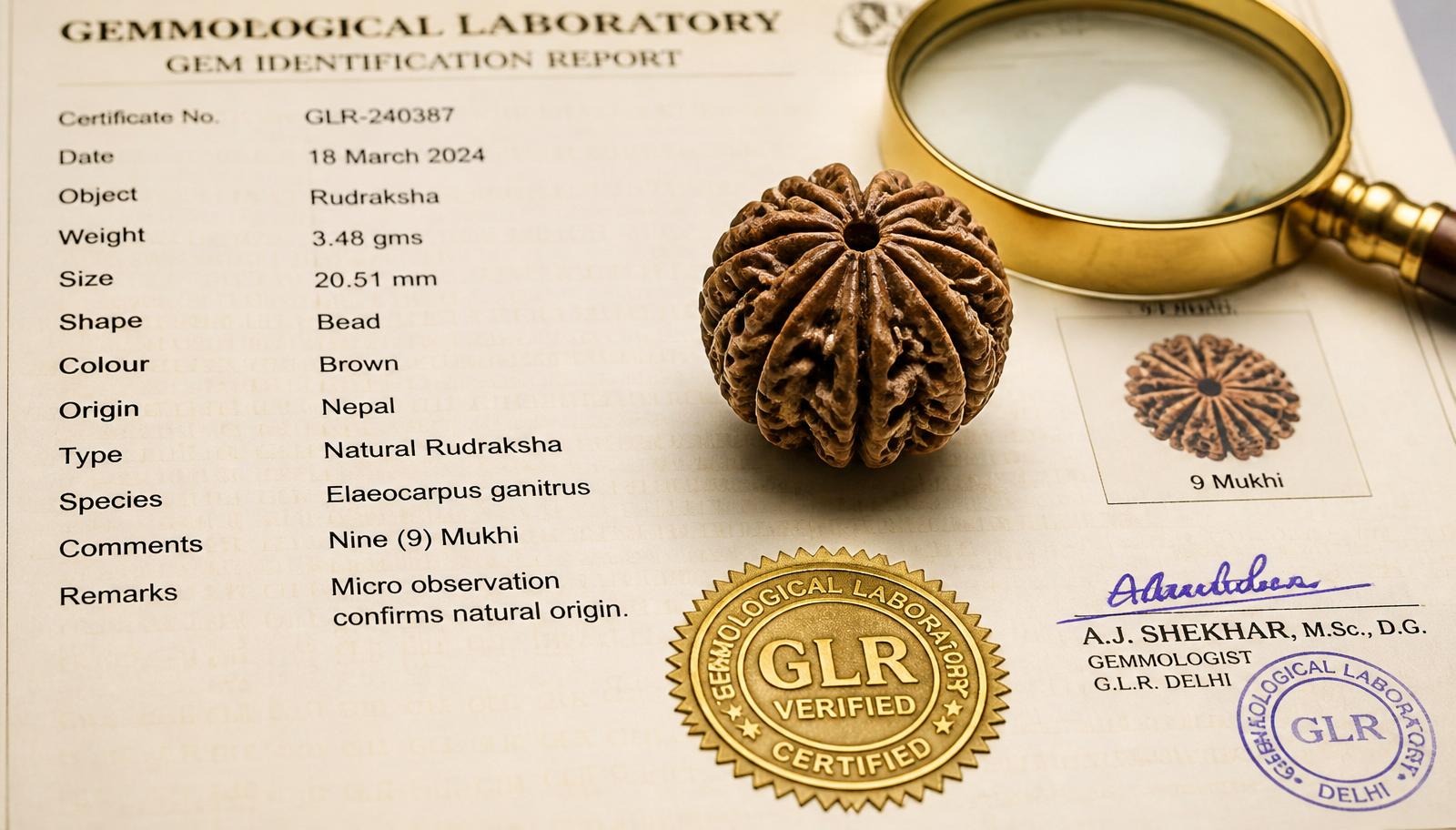
What a Genuine Certificate Contains
A real IGL/GTL Rudraksha certificate includes ALL of the following:
- Unique certificate number — verifiable on the lab's website
- Bead photograph — front and back, high resolution
- X-ray image — showing internal seed compartments
- Precise measurements — size, weight, mukhi count
- Origin — Nepal, Indonesia, etc.
- Quality grade — A, AA, AAA or similar rating
- Signature — of a certified gemologist with credentials listed
- Date of testing — usually within 6 months of your purchase
- Lab embossed seal & hologram — physical anti-counterfeit features
- QR code — links to online verification page
Red Flags — Fake Certificates
Watch for these dead giveaways:
- "In-house Certificate of Authenticity" — worthless. Any bead comes with one; the seller certifying their own bead is not verification.
- Certificate has no visible X-ray image — impossible for genuine lab, X-ray is mandatory
- Cannot be verified online — every genuine lab has a public certificate lookup
- Photocopied or printed certificate — real certificates use security paper with holograms
- Grammatical errors, typos, poor formatting — labs are professional operations
- No gemologist name/signature — real certificates identify the individual who tested
- Same certificate number as another bead — labs assign unique numbers per bead
- "Certified by our resident astrologer" — astrologers don't certify beads; gemologists do
- Certificate cost included "free" — a real IGL cert costs ₹500-1,500; sellers can absorb this but shouldn't hide it
How to Verify a Certificate is Genuine
1. Note the certificate number and lab name
2. Visit the lab's official website (e.g., iglindia.com, gtljaipur.com)
3. Use their "Verify Certificate" tool — enter number, date, and gemologist name
4. Cross-check the photograph — should match the bead you received exactly
5. Match X-ray image — the internal compartments should be clearly visible and match the external mukhi count
6. Call the lab directly — reputable labs like IGL will confirm certificate authenticity over phone in 30 seconds
When Do You Need Certification?
| Bead Type | Certification | Reason |
|---|---|---|
| Nepali 1 Mukhi | MANDATORY | Very expensive; extremely common fakes |
| Nepali 7-14 Mukhi | MANDATORY | Expensive; misgraded frequently |
| Nepali 2-6 Mukhi (>18mm) | HIGHLY RECOMMENDED | Adds ₹500-1,000 but proves genuine |
| Nepali 5 Mukhi (small) | Recommended | Common but worth verifying |
| Indonesian 5-9 Mukhi (single) | Optional | Low value; return policy sufficient |
| Indonesian mala (108+1) | Not needed per bead | Batch certification acceptable |
| Gauri Shankar | MANDATORY | Expensive; extensively faked |
| Ganesh Mukhi | MANDATORY | Expensive; growth-defect fakes common |
| Kavach combinations | MANDATORY | Verify each key bead |
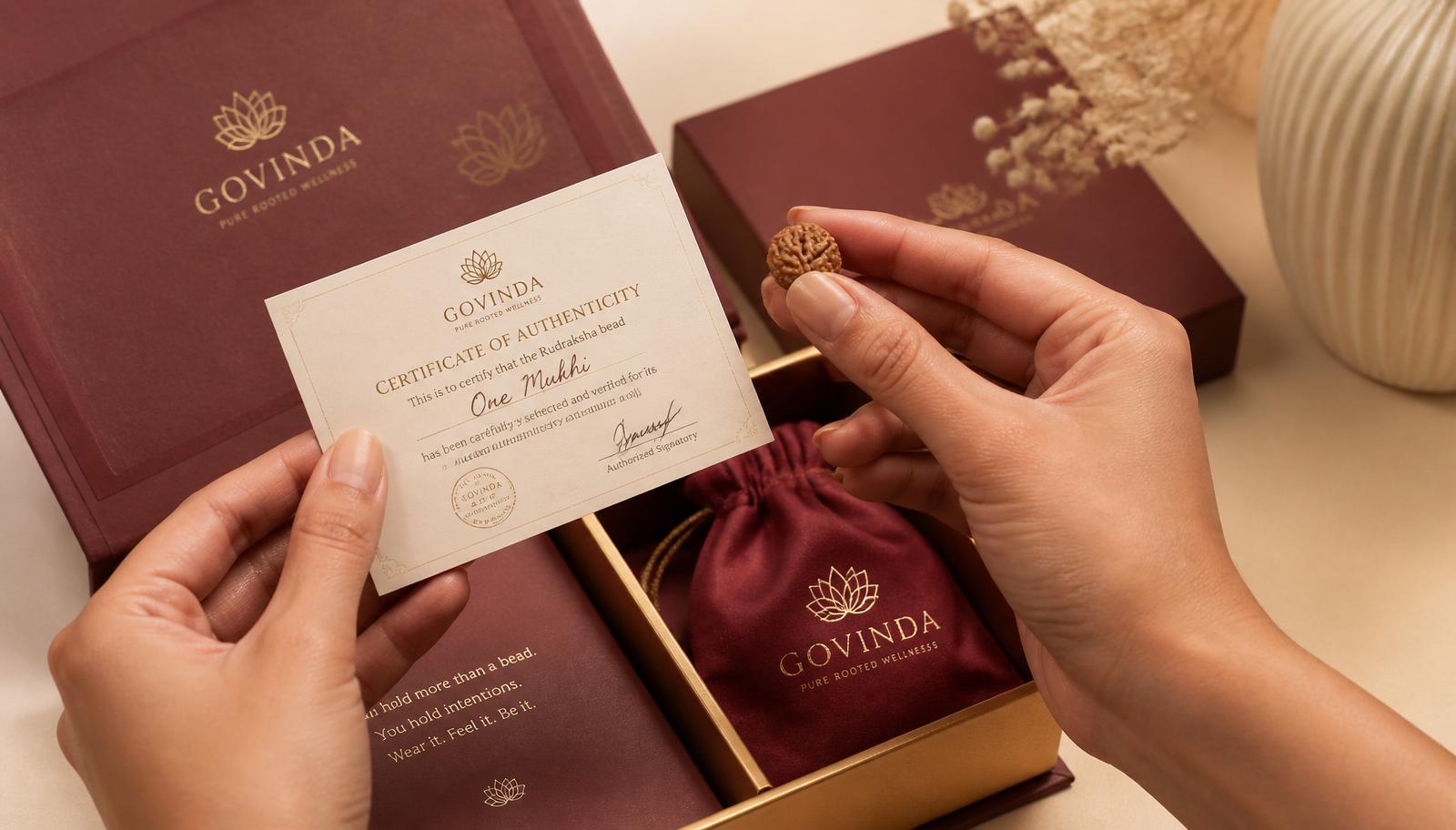
Pran-Pratishtha Certificate — What About This?
A Pran-Pratishtha certificate is different from a lab certificate. It confirms that the bead has been ritually energised (consecrated) by a qualified Vedic acharya via specific mantras and rituals — typically performed during Shravan Somvar, Mahashivratri or on the customer's request.
This certificate is spiritual, not scientific. It should be signed by the actual acharya (with credentials — Vedacharya, Panditji title, etc.), specify the mantras used, date and location of the ritual, and ideally the type of puja performed (Rudra Abhishek, Shiv Sahasranama, etc.).
A genuine certified bead has BOTH: an independent lab certificate (scientific authenticity) AND a Pran-Pratishtha certificate (spiritual energisation).
The Mauhurtika Rudraksha Certification Promise
Every Mauhurtika Rudraksha above ₹500 ships with:
- Independent IGL or GTL lab certificate (verifiable online)
- X-ray verification page attached
- Pran-Pratishtha certificate signed by our resident acharya
- 7-day money-back guarantee if you're unsatisfied with authenticity
- Free re-verification support — send us any competitor's certificate for a second opinion
Expert Recommendation
Expert Recommendation: For any bead you're paying over ₹1,500 for, insist on a third-party IGL, GTL or GJEPC certificate before purchase. Ask the seller to send you the certificate PDF and X-ray image via WhatsApp or email — a genuine seller will do this happily within an hour. Anyone who refuses or delays is a red flag. For beads below ₹500 (small Indonesian), skip the certificate and rely on a written return policy.
People Also Ask (FAQ)
Shop Certified
Every Mauhurtika Rudraksha above ₹500 includes independent IGL or GTL certification and Pran-Pratishtha puja certificate. Browse our premium 108+1 malas — each mala includes batch certification for the beads used.
Frequently Asked Questions
Q.Is a Rudraksha certificate really worth the extra money?
For beads above ₹1,000 — absolutely yes. The certificate itself costs ₹500-1,500 but protects your investment (₹2,000-50,000+), gives you legal recourse against fraud, and proves the bead's power via authentication. For a ₹200 Indonesian bead, skip it.
Q.Can a certified Rudraksha still be fake?
If the certificate is genuine (verifiable on the lab's website) and matches your bead, then no — labs stake their reputation on their certifications. The scam pattern to watch for is fake certificates presenting fake beads as certified. Always verify the certificate on the lab's official site.
Q.What's the difference between lab certificate and astrologer certificate?
A lab certificate is scientific — it proves natural origin, mukhi count and origin via X-ray. An astrologer certificate is spiritual — it confirms consecration and may recommend usage. Both have value; only the lab certificate proves authenticity.
Q.Does a Pran-Pratishtha ritual add real value?
Yes, if performed by a qualified acharya with proper mantras and duration. A genuine Rudra Abhishek + Pran-Pratishtha costs ₹500-2,000 in ritual fees; a bead sold with this ritual should reflect that value.
Q.Can I get an existing Rudraksha certified after purchase?
Yes. Take it to any IGL/GTL lab office (Delhi, Mumbai, Jaipur, Bangalore, Kolkata all have offices) with ₹500-1,500 cash. Most labs return the certificate within 24-48 hours. You can also courier the bead with insurance.
Q.Are online certificate verification systems reliable?
For genuine labs — extremely reliable. IGL, GTL and GJEPC all maintain public databases where you can enter certificate number + gemologist name and see the exact bead's report within seconds.
Q.How long is a Rudraksha certificate valid?
Indefinitely. The bead is a fixed physical object; its characteristics don't change. A 10-year-old certificate for a bead you still own is fully valid.
Q.What if my certified bead breaks?
The certificate proves it was originally genuine. Contact your seller for a replacement — reputable retailers offer discounted replacements for cracked genuine beads (typically 30-40% off the original price).
Related Articles
Rudraksha Price Guide 2026: How Much Does an Original Rudraksha Cost in India? (Real Market Rates)
Rudraksha Beads Size Guide (18mm–35mm): Which Size Should You Choose? (2026)