Rudraksha Beads Size Guide (18mm–35mm): Which Size Should You Choose? (2026)
Complete Rudraksha size guide — what 18mm, 20mm, 22mm, 25mm, 30mm and 35mm beads look like, feel like, cost, and which size is best for pendants, malas, bracelets and specific purposes.
Quick Answer: For a single-bead pendant, choose 20-25 mm Nepali beads (visible, premium presence). For a 108+1 japa mala, choose 6-9 mm beads (comfortable to roll during mantra chanting). For a bracelet, choose 8-11 mm. Sizes above 30 mm are collector-grade — premium spiritual value but impractical for daily wear.
One of the most common questions I receive from customers considering their first serious Rudraksha purchase is: "What size should I buy?" The right answer depends on how you plan to wear it, your budget, and (surprisingly) your body size and dominant hand.
This complete guide explains every popular size in the 18-35 mm range, with real-world comparisons, use cases, and pricing.
Understanding Rudraksha Sizing
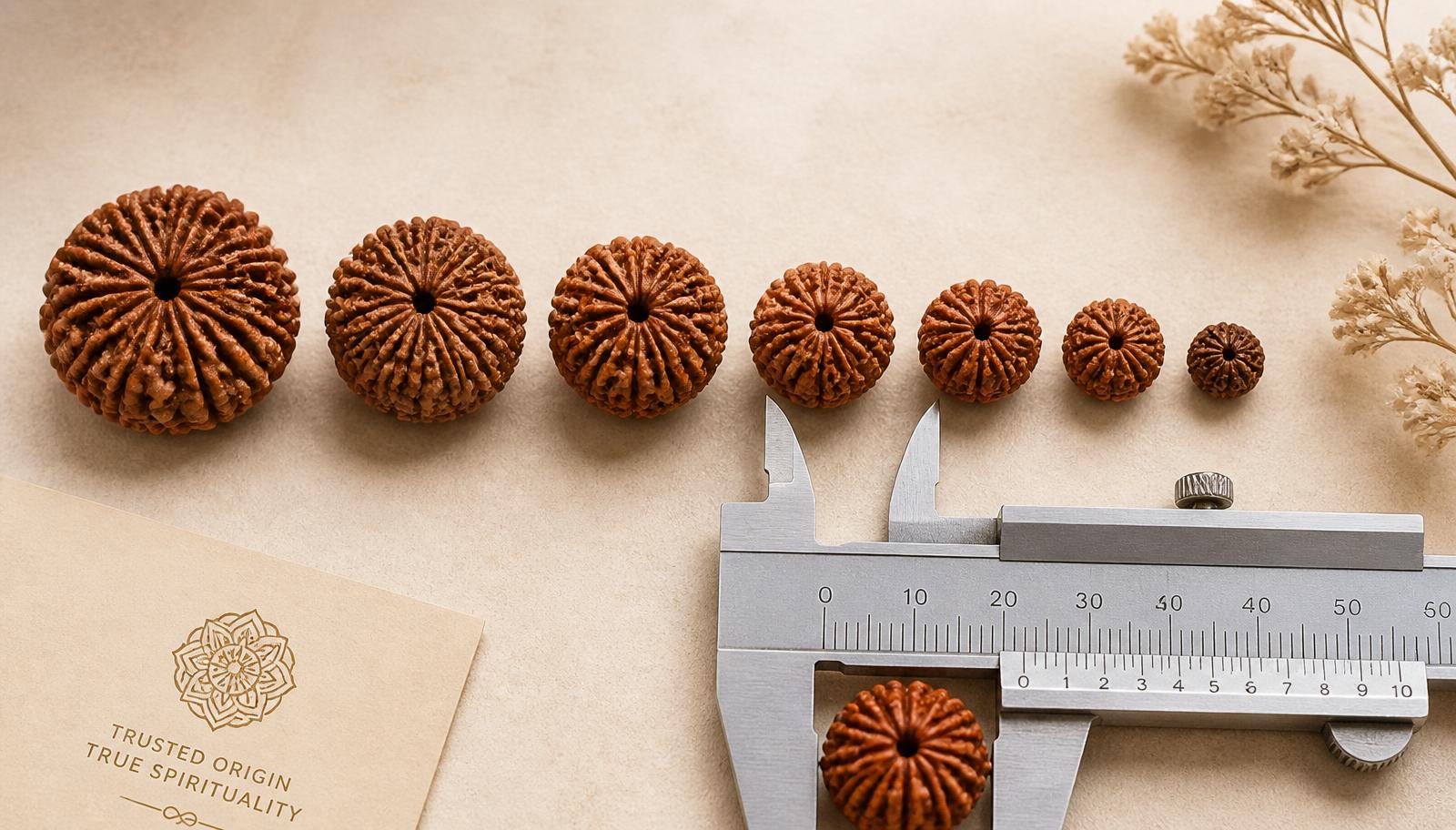
Rudraksha size is measured across the widest diameter of the bead, typically with a vernier caliper. The industry standard is millimetres (mm).
| Origin | Typical Size Range | Character |
|---|---|---|
| Indonesian (Java) | 5-15 mm | Small, uniform, lightweight |
| Nepali | 15-30 mm | Large, heavy, deep mukhi lines |
| Haridwar/Indian | 10-20 mm | Medium, moderate weight |
| Collector Nepali | 30-40 mm+ | Rare, museum-grade |
Complete Size × Use-Case Guide
18 mm — The Starter Size
Look: Slightly smaller than a large marble; discreet enough to wear under clothing.
Weight: ~2-3 grams.
Best for: First-time buyers, women who prefer subtle jewellery, corporate professionals, pendants worn under formal shirts.
Price: ₹1,200-1,800 for Nepali 5 Mukhi.
Verdict: ✅ Excellent starter — genuine premium presence without visual overload.
20 mm — The Sweet Spot
Look: Perfect visual balance; visible on the chest without being ostentatious.
Weight: ~3-4 grams.
Best for: Everyday pendants for men, spiritual seekers wanting a visible bead, gift purchases.
Price: ₹1,500-2,500 for Nepali 5 Mukhi.
Verdict: ✅ Most recommended by acharyas — the classic "proper" size.
22 mm — Premium Daily Wear
Look: Substantial and unmistakable; commands quiet attention.
Weight: ~4-5 grams.
Best for: Serious daily wearers, sadhakas, gifts for spiritual mentors.
Price: ₹2,000-3,500 for Nepali 5 Mukhi.
Verdict: ✅ Premium sweet spot — noticeable step up from 20 mm.
25 mm — Luxury Grade
Look: Impressive; the bead becomes a focal jewellery piece.
Weight: ~5-7 grams.
Best for: Statement pendants, collectors, gifts for gurus and elders.
Price: ₹3,500-6,000 for Nepali 5 Mukhi.
Verdict: ✅ Investment grade — 4-5× rarer than 20 mm beads.
28 mm — Rare Premium
Look: Prominent centrepiece; requires premium silver or gold capping to balance.
Weight: ~7-9 grams.
Best for: Collectors, temple offerings, statement puja room installations.
Price: ₹6,000-12,000 for Nepali 5 Mukhi.
Verdict: ⚠️ Beautiful but requires care — heavier beads swing more and can crack if dropped.
30 mm+ — Collector & Ritual Grade
Look: Museum piece; often reserved for temple puja rather than daily wear.
Weight: 9-15 grams.
Best for: Family altar centrepieces, gifts to spiritual institutions, investment collectors.
Price: ₹12,000-40,000+ for Nepali 5 Mukhi.
Verdict: ⚠️ Extremely rare — verify authenticity aggressively; fakes are common at this size.
35 mm+ — Ultra-Rare
Look: The size of a small walnut; genuinely museum-worthy.
Best for: Serious collectors only.
Price: ₹40,000-1,50,000+.
Verdict: 🔴 Buy only from top-tier certified sources with X-ray verification — 90%+ of "35 mm" beads on the market are fakes.
Size Guide by Wearing Form
| Wearing Form | Recommended Size | Why |
|---|---|---|
| Pendant (silver-capped) | 20-25 mm Nepali | Visible, premium, comfortable weight |
| Kanthi (27-bead neck mala) | 10-14 mm | Snug fit without heaviness |
| 108+1 Japa Mala | 6-9 mm Nepali OR 5-8 mm Indonesian | Comfortable to roll during mantras |
| Bracelet (27 beads) | 8-11 mm | Comfortable on wrist, no snagging |
| Ganesh/1 Mukhi centre bead in Rudra Kavach | 22-28 mm | Focal point of the combination |
| Puja altar centrepiece | 28-35 mm+ | Ritual presence, worshipped not worn |
Size vs Vibration — Does Bigger Mean More Powerful?
This is a hotly debated question. The traditional Vedic answer: yes, larger beads carry stronger vibration because they contain more of the natural bio-electric compartments. Modern research (Dr Suhas Roy, IIT Banaras) partially confirms this — larger beads showed marginally stronger paramagnetic properties.
However, the difference between a 20 mm and 25 mm bead is subtle — perhaps 10-15% stronger vibration. The difference between a genuine 20 mm and a fake 30 mm is infinite. Prioritise authenticity over size.
Expert Recommendation by Body Size
| Wearer | Recommended Pendant Size | Reason |
|---|---|---|
| Small-framed woman | 18-20 mm | Proportional, elegant |
| Average-framed woman | 20-22 mm | Classic feminine premium |
| Small-framed man | 20-22 mm | Balanced presence |
| Average-framed man | 22-25 mm | Confident, unmistakable |
| Larger-framed man | 25-28 mm | Proportional statement |
| Child (5-12 years) | 12-16 mm | Comfortable, safe, non-choking |
| Teenager | 16-20 mm | Growing into adult size |
Expert Recommendation
Expert Recommendation: For your first serious purchase, buy a certified Nepali 5 Mukhi Rudraksha in 20-22 mm capped in 92.5 silver. This size is the acharya-approved standard — large enough to feel premium, small enough for all-day comfort, and priced fairly at ₹2,000-3,500 including capping. Skip both extremes (below 18 mm or above 28 mm) for a first purchase.
People Also Ask (FAQ)
Shop by Size
Browse our complete Rudraksha collection filtered by size, or explore our premium 108+1 malas in 6-12 mm bead sizes. Every bead is measured, photographed and certified before shipping.
Frequently Asked Questions
Q.Is a bigger Rudraksha bead more powerful?
Marginally, yes — larger beads have more internal compartments and stronger measurable paramagnetic properties. But the effect is subtle (10-15% difference between 20mm and 25mm), and authenticity matters infinitely more than size.
Q.What size is best for a japa mala?
6-9 mm Nepali or 5-8 mm Indonesian beads. Larger beads (10 mm+) are uncomfortable to roll during 108-round mantra chanting and make the mala too heavy to hold for long sessions.
Q.Are 5-8 mm Indonesian beads too small to be effective?
No. Indonesian beads carry the same vibration per bead as Nepali — they are simply a different grade. A 108+1 mala of small Indonesian beads is highly effective for daily japa and is what most traditional yogis actually use.
Q.Which size is best for children?
12-16 mm beads capped in silver, worn as a short mala or bracelet. Safe, comfortable, and easy for children to handle without damage.
Q.What is the largest genuine Rudraksha ever recorded?
Documented specimens up to 42 mm exist in temple collections in Nepal and India, but beads above 30 mm are extremely rare in the commercial market. 90%+ of "35 mm+" beads sold online are fakes.
Q.Does size affect Rudraksha price a lot?
Yes — dramatically. A Nepali 5 Mukhi at 18 mm costs ~₹1,200; at 25 mm it costs ~₹3,500; at 30 mm it costs ~₹12,000+. Size and price scale almost exponentially above 22 mm.
Q.Can I mix bead sizes in a single mala?
Traditionally, a japa mala uses uniform bead sizes for smooth rotation. However, a Rudra Kavach combination intentionally uses different mukhis and sizes for symbolic and vibrational reasons.
Related Articles
Rudraksha Price Guide 2026: How Much Does an Original Rudraksha Cost in India? (Real Market Rates)
Certified vs Non-Certified Rudraksha: What Really Matters? (Complete 2026 Guide)