Rudraksha Japa Mala: 108+1 Beads, How to Use & Complete Guide
A practical guide to mantra japa with a Rudraksha mala: the 108+1 structure, the Meru bead, hand and finger position, counting rounds, meditation, choosing a mala and the most common mistakes.
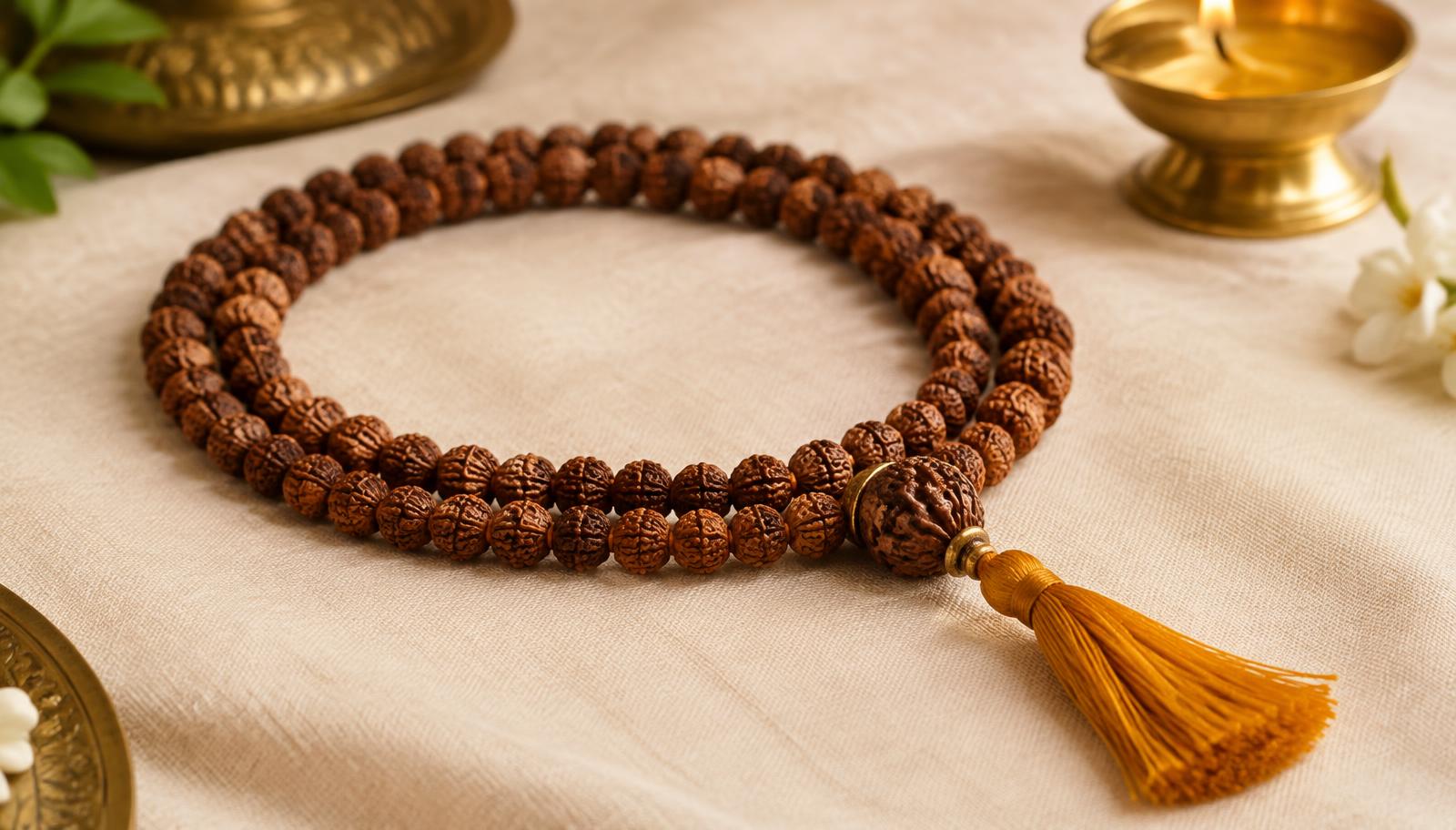
A Rudraksha Japa Mala is a string of 108 Rudraksha beads plus one Meru (Guru) bead used to count mantra repetitions. You hold it in the right hand, move one bead with the thumb for each repetition, and complete one round of 108 when you return to the Meru. Many traditions turn the mala around at the Meru instead of crossing it.
Japa — the quiet, repeated recitation of a mantra or divine name — is one of the oldest and simplest spiritual practices in India. It needs no special equipment, but almost every tradition uses a mala to keep count, so the mind can rest on the mantra instead of on numbers. This guide is about the practice itself: how to hold the mala, how to count, how to handle the Meru, how japa connects with meditation, and the small habits that make daily chanting sustainable.
What Is a Rudraksha Japa Mala?
A japa mala is a counting tool for mantra repetition. The word *japa* means muttering or repeating, and *mala* means garland. A Rudraksha japa mala uses Rudraksha seeds as its beads, which in Shaiva tradition makes it the preferred mala for Shiva mantras such as *Om Namah Shivaya* and the Mahamrityunjaya Mantra.
Malas are also made of tulsi, sphatik (quartz crystal), sandalwood, lotus seed and other materials, and different traditions pair different materials with different deities. Rudraksha is especially associated with Lord Shiva, but many people use it for other mantras too. If you are weighing materials, our Rudraksha vs Tulsi mala comparison explains the traditional distinctions.
Why Are 108+1 Beads Used?
The 108 beads carry the count. One full pass from the Meru round to the Meru again equals 108 repetitions — traditionally called one *mala* or one round.
The number 108 is considered sacred across Hindu, Buddhist and Jain traditions, and several symbolic explanations are given, such as 27 nakshatras × 4 padas or 12 rashis × 9 grahas. Practically, it is a substantial but manageable count: a round typically takes somewhere between five and fifteen minutes, depending on the length of the mantra and your pace.
Some traditions note that the extra repetitions beyond 100 compensate for any mistakes or lapses of attention during the round — a gentle way of acknowledging that the mind will wander.
What Is the Meru or Guru Bead?
The Meru (also called Sumeru or Guru bead) is the single bead set apart from the 108, usually slightly larger and often finished with a tassel. It is named after Mount Meru, the cosmic mountain at the centre of the universe in Hindu cosmology.
It serves two purposes. Practically, it tells you by touch where the round begins and ends, so you never need to look. Symbolically, many traditions treat it as representing the guru or the deity, which is why it is not used for counting and is handled with respect.
How Does Japa Mala Work?
The mala turns an abstract count into a physical rhythm. Each repetition is paired with one small movement of the thumb. After a little practice, the hand keeps the count automatically, and attention can stay with the sound and meaning of the mantra.
This pairing of breath, voice or inner sound, and movement is why many people find a mala easier than counting in their head or on their fingers, and why the tactile texture of Rudraksha beads — with their distinct ridges — is valued: each bead is clearly separate under the thumb.
How to Use a Rudraksha Japa Mala
Before you begin
- Place: choose a clean, quiet spot. Many people use the same corner each day.
- Time: early morning (traditionally Brahma Muhurta, before sunrise) and evening are popular, but a consistent time matters more than the exact hour.
- Seat: sit on an asana — a mat, folded cloth or kusha grass mat — rather than directly on the floor.
- Direction: facing east or north is traditional in many households.
- Mantra: decide your mantra before you start. If you have received one from a guru, use that.
Hand and finger position
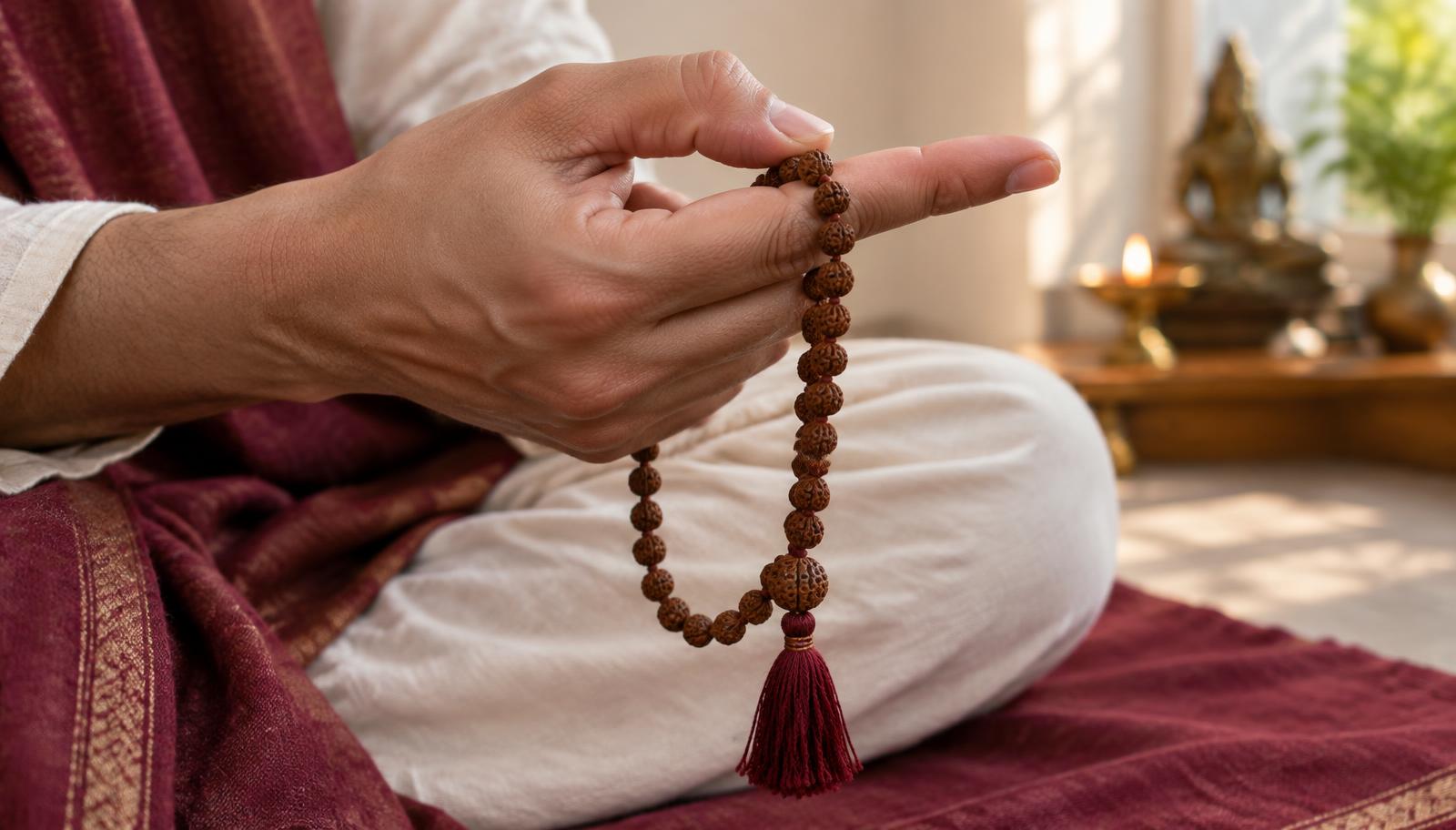
In the most widely taught method, the mala rests over the middle finger (or ring finger) of the right hand. The thumb moves each bead toward you. The index finger is kept away from the beads — it is traditionally associated with ego and pointing at others. Some traditions keep the hand at heart level; others let it rest on the knee or inside a cloth bag called a *gomukhi*. Practices vary, and none is universally mandatory.
Step-by-Step Mantra Japa Practice
1. Settle: sit upright with a relaxed spine. Take a few slow breaths.
2. Invoke: many begin with a short prayer to Ganesha or their guru, or simply a moment of intention (sankalpa).
3. Find the start: hold the Meru between thumb and finger, then move to the first bead beside it.
4. Chant one repetition: recite the mantra once — aloud, whispered, or mentally.
5. Move one bead: with the thumb, pull the bead toward you over the finger, so the next bead comes into position.
6. Repeat: continue, one repetition per bead.
7. Reach the Meru: after 108 beads, your thumb meets the Meru. That completes one round.
8. Continue or close: to start another round, turn the mala around (see below). When finished, sit quietly for a minute before getting up.
There are three traditional styles of chanting: *vachika* (audible), *upamshu* (whispered, lips moving) and *manasika* (purely mental). Many teachers suggest beginning aloud or whispered, since it is easier to stay focused, and moving toward mental japa as concentration deepens.
How to Count Mantras Using 108+1 Beads
One round of the mala equals 108 repetitions. To track multiple rounds, people use a few simple methods:
| Rounds completed | Total repetitions |
|---|---|
| 1 | 108 |
| 3 | 324 |
| 5 | 540 |
| 11 | 1,188 |
| 21 | 2,268 |
| 108 | 11,664 |
- Counter beads: some malas have small sliding markers on a separate cord to record rounds.
- Grains or pebbles: set aside one grain of rice or a small stone for each completed round.
- A notebook: write the number of rounds after each session. This also builds a record of your practice.
If you lose count in the middle of a round, the usual advice is simply to continue calmly from where you are, or restart that round. Do not let worry about exact numbers disturb the practice.
Should You Cross the Guru/Meru Bead?
In many Hindu traditions, you do not cross the Meru. When you reach it after 108 beads, you turn the mala around and begin the next round in the opposite direction. The reasoning given is respect for the guru or deity it represents.
Not every tradition follows this. Some lineages pass over the Meru, and Buddhist and other practices have their own conventions. If you have a teacher, follow their instruction. If you do not, turning the mala is the most commonly taught approach in Shaiva and general Hindu practice.
Rudraksha Japa Mala for Meditation
A mala can anchor meditation even when you are not counting a specific number. Some people use it in these ways:
- Breath-paired japa: one bead per exhalation, with the mantra repeated silently.
- Name-meditation: one bead per repetition of a divine name, letting the pace slow naturally.
- Silent holding: simply holding the mala as a tactile reminder to return to the present when the mind drifts.
Devotees often report feeling calmer and more focused after a session. Those are personal and spiritual experiences; they are not a medical treatment, and anyone dealing with a health condition should consult a qualified professional.
Which Rudraksha Is Commonly Used for Japa Mala?
Almost all japa malas are made with 5 Mukhi beads, because they are plentiful, uniform and traditionally considered suitable for everyone. Other mukhis appear in malas too, usually for specific purposes and at higher cost:
- 5 Mukhi: the general-purpose choice for most mantras, especially Shiva mantras.
- Mixed-mukhi or Siddha malas: combine several mukhis; usually worn rather than used for counting.
- Other single-mukhi malas (for example 6 or 7 Mukhi): chosen on specific traditional or astrological advice.
5 Mukhi Rudraksha Japa Mala
If you are buying your first japa mala, a 5 Mukhi mala is the default most teachers recommend. Beads in the 5–8 mm range are comfortable for long sessions. For a detailed look at bead origins, authenticity markers and what affects cost, read our 5 Mukhi Rudraksha Mala guide — it focuses on choosing and buying the mala itself, while this article focuses on the practice.
Nepali vs Indonesian Rudraksha Japa Mala
From a practice point of view, the main difference is how the mala feels in the hand during a long session:
- Indonesian (Java) beads: small, light and smooth-ridged. Easy on the thumb during many rounds; a popular choice for daily japa.
- Nepali beads: heavier, with deep, pronounced ridges that give a strong tactile sense of each bead. Japa malas use smaller selected Nepali beads, which cost more.
Neither is traditionally considered more effective. Choose the one that feels right during actual chanting.
How to Choose a Japa Mala
- Bead size: 5–8 mm for counting; larger for wearing.
- Knots between beads: knotted stringing stops beads rubbing and makes each one distinct under the thumb.
- Thread versus wire: thread is quiet and flexible; wire is durable but less fluid for fast japa.
- Clear Meru and tassel: the Meru should be easy to locate by touch.
- Length: a full 108+1 for traditional rounds; 54+1 or 27+1 if you prefer shorter practice.
You can browse Rudraksha malas by origin, bead count and Mukhi in our collection.
Authenticity and Quality Checklist
- Mukhi lines run naturally from top to bottom of each bead.
- Beads show slight natural variation — not identical, moulded or glossy like plastic.
- Natural central holes, not off-centre drill marks.
- No strong dye that rubs off on cloth.
- Origin, bead size and bead count are clearly stated.
- An independent lab report is available on request for significant purchases.
Avoid relying on floating, coin-spinning or milk tests, which are not reliable. Our original Rudraksha identification guide explains what actually works.
Japa Mala Care and Storage
- Keep your japa mala in a clean cotton or silk pouch when not in use.
- Many practitioners keep the japa mala reserved for chanting rather than lending it out — a widely followed custom, though not universal.
- Avoid water, soap and perfume on the beads.
- Brush dust from the grooves occasionally and apply a little natural oil every few months.
- Watch for thread wear near the Meru, where tension is highest, and restring when it frays.
Common Mistakes While Using a Japa Mala
- Rushing: speed is not the goal. A slower round with attention is generally valued over many hurried ones.
- Using the index finger: most traditions keep it off the beads.
- Letting the mala touch the floor: it is customary to keep it on a cloth or in the lap.
- Counting the Meru: it marks the round and is not one of the 108.
- Switching mantras every day: most teachers advise staying with one mantra for a sustained period.
- Worrying about perfection: a wandering mind is normal. Gently return to the mantra each time.
For mantra options, see our collection of Shiva mantras for Rudraksha japa.
Frequently Asked Questions
Conclusion
A Rudraksha Japa Mala is a simple tool that supports a deep practice. Hold it in the right hand, move one bead per repetition, treat the Meru with respect, and keep track of rounds in whatever way is easy for you. Where traditions differ — on crossing the Meru, on daily wear, on hand position — follow your teacher or family practice. Above all, consistency matters more than numbers: a few attentive rounds every day will serve you better than many rushed ones.
Frequently Asked Questions
Q.How many beads are in a Rudraksha Japa Mala?
Traditionally 108 counting beads plus one Meru bead, written as 108+1. Shorter 54+1 and 27+1 versions are also used.
Q.Which hand should I use for japa?
Most traditions use the right hand, with the mala resting over the middle or ring finger and the thumb moving the beads.
Q.Should I cross the Meru bead?
Many Hindu traditions turn the mala around at the Meru rather than crossing it. Some lineages differ, so follow your teacher if you have one.
Q.Can I chant mentally with a japa mala?
Yes. Audible, whispered and mental japa are all traditional; many people progress from audible to mental chanting.
Q.Which mantra should I chant on a Rudraksha mala?
Om Namah Shivaya is the most common with Rudraksha. Any mantra given by your guru or followed in your family tradition can be used.
Q.Does japa with a Rudraksha mala have medical benefits?
Japa is a spiritual practice. Many people find it calming, but it is not a medical treatment and should not replace professional care.