108 Names of Lord Hanuman: Meanings, Mantras & Significance
The Hanuman Ashtottara Shatanamavali — all 108 names with transliteration and meaning — plus why 108 matters, how devotees recite the names on Tuesdays and Saturdays, and the link with Hanuman Chalisa and Rudraksha.
The Hanuman Ashtottara Shatanamavali is a list of 108 names of Lord Hanuman, each recited as “Om [name] namah”. Every name recalls a quality or an episode from the Ramayana — his strength, devotion, wisdom or service. Devotees traditionally recite the full list on Tuesdays, Saturdays and Hanuman Jayanti, often using a 108-bead mala.
Lord Hanuman is loved across India as the ideal devotee: immensely strong, yet wholly humble before Shri Rama. Reciting his names is one of the simplest forms of his worship. This guide explains the practice and gives the complete list with meanings.
Why 108 Is Traditionally Significant
108 is a sacred number across Hindu, Buddhist and Jain traditions. Common explanations include the 27 nakshatras multiplied by their 4 padas (27 × 4 = 108), the 12 zodiac signs multiplied by the 9 grahas (12 × 9 = 108), and the 108 Upanishads of the Muktika canon. Whatever the reasoning, a japa mala has 108 beads so that one full round completes one cycle of names or mantras.
What Is Hanuman Ashtottara Shatanamavali?
Ashtottara Shata means “one hundred and eight”, and namavali means “a garland of names”. Several deities have their own namavali; Hanuman's is recited in temples during archana (offering flowers or kumkum with each name) and at home as a devotional practice.
How to Recite Each Name
Each name is recited in the dative form with “Om” and “namah”. For example: “Om Anjaneyaya Namah”, “Om Mahaviraya Namah”, “Om Hanumate Namah”. In the table, names are given in their base form for readability; when chanting, add the ending your book uses.
The 108 Names of Lord Hanuman
| No. | Name (base form) | Meaning |
|---|---|---|
| 1 | Anjaneya | Son of Mother Anjana |
| 2 | Mahavira | The supremely brave one |
| 3 | Hanumat | One with a prominent jaw |
| 4 | Marutatmaja | Son of Vayu, the wind god |
| 5 | Tattvajnanaprada | Giver of knowledge of the truth |
| 6 | Sitadevimudrapradayaka | Who delivered Rama's ring to Sita |
| 7 | Ashokavanakacchetre | Who uprooted the Ashoka grove in Lanka |
| 8 | Sarvamayavibhanjana | Destroyer of all illusions |
| 9 | Sarvabandhavimoktre | Releaser from all bonds |
| 10 | Rakshovidhvansakaraka | Slayer of demons |
| 11 | Paravidyaparihara | Who wards off hostile occult knowledge |
| 12 | Parashauryavinashana | Who humbles the valour of enemies |
| 13 | Paramantranirakartre | Who neutralises hostile mantras |
| 14 | Parayantraprabhedaka | Who breaks hostile yantras |
| 15 | Sarvagrahavinashin | Remover of all troubling influences |
| 16 | Bhimasenasahayakrit | Helper of Bhima |
| 17 | Sarvaduhkhahara | Remover of all sorrow |
| 18 | Sarvalokacharin | Who moves through all worlds |
| 19 | Manojava | Swift as the mind |
| 20 | Parijatadrumulastha | Who dwells at the root of the Parijata tree |
| 21 | Sarvamantrasvarupavat | Embodiment of all mantras |
| 22 | Sarvatantrasvarupin | Embodiment of all tantras |
| 23 | Sarvayantratmaka | Essence of all yantras |
| 24 | Kapishvara | Lord of the vanaras |
| 25 | Mahakaya | Of gigantic form |
| 26 | Sarvarogahara | Traditionally invoked against all afflictions |
| 27 | Prabhu | The master |
| 28 | Balasiddhikara | Giver of strength and accomplishment |
| 29 | Sarvavidyasampatpradayaka | Giver of learning and wealth |
| 30 | Kapisenanayaka | Commander of the vanara army |
| 31 | Bhavishyacchaturanana | Destined to hold the office of Brahma |
| 32 | Kumarabrahmacharin | The youthful celibate |
| 33 | Ratnakundaladiptimat | Radiant with jewelled earrings |
| 34 | Chanchaladvalasannaddhalambamanashikhojjvala | Whose waving tail shines above his head |
| 35 | Gandharvavidyatattvajna | Knower of the celestial musical arts |
| 36 | Mahabalaparakrama | Of great strength and prowess |
| 37 | Karagaravimoktre | Liberator from imprisonment |
| 38 | Shrinkhalabandhamochaka | Who loosens chains |
| 39 | Sagarottaraka | Who leapt across the ocean |
| 40 | Prajna | The wise one |
| 41 | Ramaduta | Messenger of Rama |
| 42 | Pratapavat | The glorious one |
| 43 | Vanara | The vanara |
| 44 | Kesarisuta | Son of Kesari |
| 45 | Sitashokanivaraka | Who dispelled Sita's grief |
| 46 | Anjanagarbhasambhuta | Born of Anjana |
| 47 | Balarkasadrishanana | Whose face glows like the rising sun |
| 48 | Vibhishanapriyakara | Beloved of Vibhishana |
| 49 | Dashagrivakulantaka | Destroyer of Ravana's clan |
| 50 | Lakshmanapranadatre | Who restored Lakshmana's life |
| 51 | Vajrakaya | Of adamantine body |
| 52 | Mahadyuti | Of great radiance |
| 53 | Chiranjivin | The immortal one |
| 54 | Ramabhakta | Devotee of Rama |
| 55 | Daityakaryavighataka | Who thwarts the deeds of demons |
| 56 | Akshahantre | Slayer of Aksha, Ravana's son |
| 57 | Kanchanabha | Of golden hue |
| 58 | Panchavaktra | The five-faced one |
| 59 | Mahatapas | Of great austerity |
| 60 | Lankinibhanjana | Who subdued Lankini |
| 61 | Shrimat | The auspicious one |
| 62 | Simhikapranabhanjana | Who overcame Simhika |
| 63 | Gandhamadanashailastha | Dweller on Mount Gandhamadana |
| 64 | Lankapuravidahaka | Who set Lanka ablaze |
| 65 | Sugrivasachiva | Minister of Sugriva |
| 66 | Dhira | The steadfast one |
| 67 | Shura | The valiant one |
| 68 | Daityakulantaka | Ender of the demon race |
| 69 | Surarchita | Worshipped by the devas |
| 70 | Mahatejas | Of great brilliance |
| 71 | Ramachudamanaprada | Who brought Sita's jewel to Rama |
| 72 | Kamarupin | Who takes any form at will |
| 73 | Pingalaksha | Of tawny eyes |
| 74 | Vardhimainakapujita | Honoured by Mount Mainaka in the ocean |
| 75 | Kabalikritamartandamandala | Who tried to swallow the sun's disc |
| 76 | Vijitendriya | Master of the senses |
| 77 | Ramasugrivasandhatre | Who united Rama and Sugriva |
| 78 | Maharavanamardana | Slayer of Mahiravana |
| 79 | Sphatikabha | Pure as crystal |
| 80 | Vagadhisha | Lord of speech |
| 81 | Navavyakritapandita | Master of the nine grammars |
| 82 | Chaturbahu | The four-armed one |
| 83 | Dinabandhu | Friend of the distressed |
| 84 | Mahatman | The great soul |
| 85 | Bhaktavatsala | Affectionate to devotees |
| 86 | Sanjivananagahartre | Who carried the mountain bearing Sanjivani |
| 87 | Shuchi | The pure one |
| 88 | Vagmin | The eloquent one |
| 89 | Dridhavrata | Firm in his vows |
| 90 | Kalanemipramathana | Slayer of Kalanemi |
| 91 | Harimarkatamarkata | Foremost among vanaras |
| 92 | Danta | The self-controlled one |
| 93 | Shanta | The peaceful one |
| 94 | Prasannatman | Of serene nature |
| 95 | Shatakanthamadapahrit | Who humbled the hundred-headed Ravana |
| 96 | Yogin | The yogi |
| 97 | Ramakathalola | Who delights in the story of Rama |
| 98 | Sitanveshanapandita | Skilled in the search for Sita |
| 99 | Vajradamshtra | With adamantine teeth |
| 100 | Vajranakha | With adamantine nails |
| 101 | Rudraviryasamudbhava | Born of Rudra's energy |
| 102 | Indrajitprahitamoghabrahmastravinivaraka | Who withstood Indrajit's Brahmastra |
| 103 | Parthadhvajagrasamvasin | Who rests atop Arjuna's chariot flag |
| 104 | Sharapanjarabhedaka | Who broke the cage of arrows |
| 105 | Dashabahu | The ten-armed one |
| 106 | Lokapujya | Worshipped by all worlds |
| 107 | Jambavatpritivardhana | Who delighted Jambavan |
| 108 | Sitasametashriramapadasevadurandhara | Ever devoted to serving Rama and Sita |
Associated Mantras
ॐ हं हनुमते नमः॥ — Om Ham Hanumate Namah (a short beej mantra of Hanuman)
ॐ आञ्जनेयाय विद्महे वायुपुत्राय धीमहि। तन्नो हनुमत् प्रचोदयात्॥ — Om Anjaneyaya vidmahe, Vayuputraya dhimahi, tanno Hanumat prachodayat. (Hanuman Gayatri)
मनोजवं मारुततुल्यवेगं जितेन्द्रियं बुद्धिमतां वरिष्ठम्। वातात्मजं वानरयूथमुख्यं श्रीरामदूतं शरणं प्रपद्ये॥ — Manojavam marutatulyavegam jitendriyam buddhimatam varishtham, vatatmajam vanarayuthamukhyam shriramadutam sharanam prapadye.
The last verse, from the Ramaraksha Stotra tradition, praises Hanuman as swift as the mind, master of the senses, foremost among the wise, and the messenger of Rama in whom the devotee takes refuge.
Devotional Significance
Each name works like a short story. Sagarottaraka recalls his leap to Lanka; Lakshmanapranadatre his journey for the Sanjivani herb; Ramaduta his role as messenger. Reciting the names is traditionally understood as a way of remembering these qualities — courage, service, self-control, humility — and inviting them into one's own life.
How Devotees Traditionally Recite the Names
1. Bathe and sit before an image of Hanuman (ideally with Shri Rama), facing east or north.
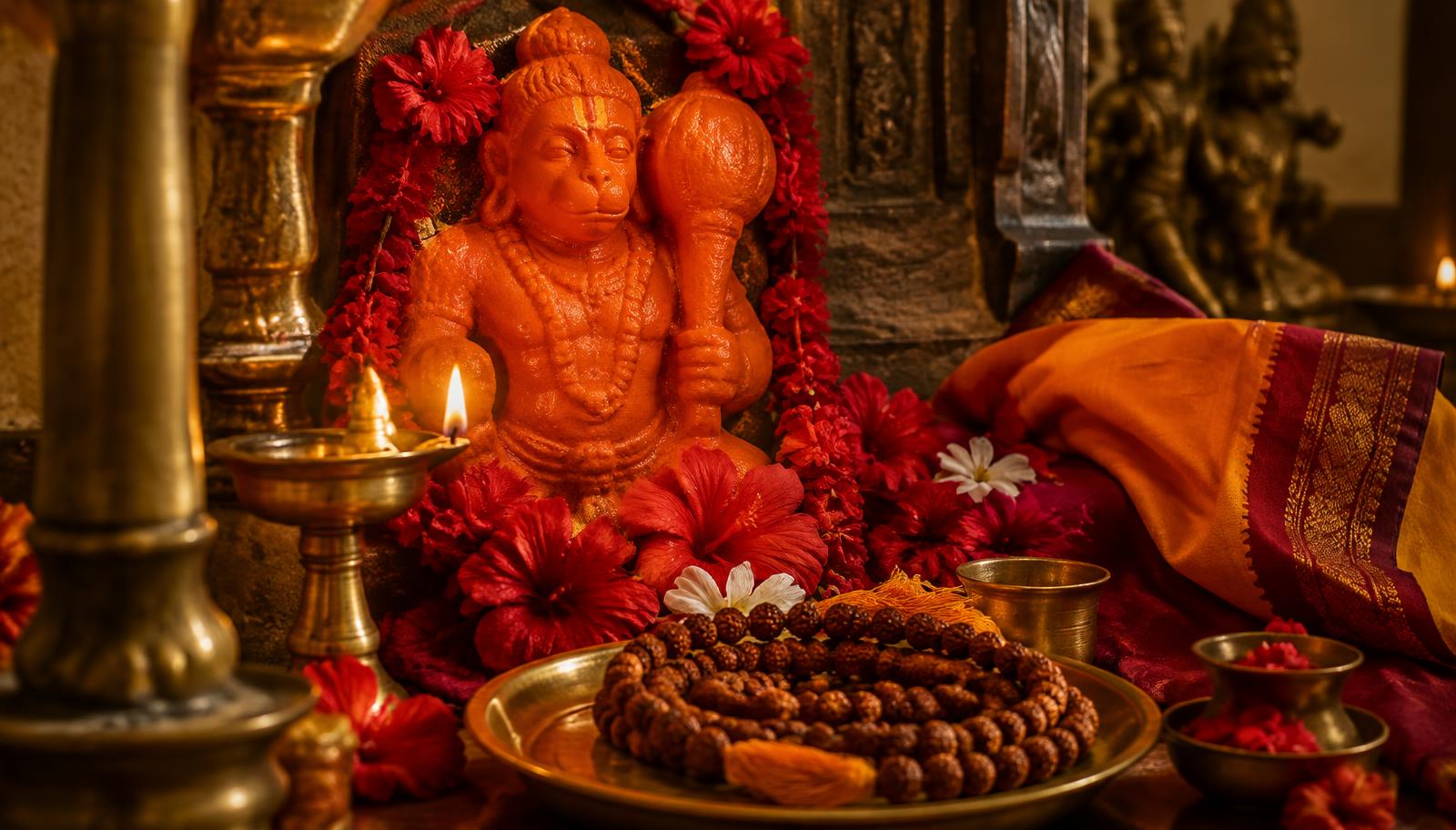
2. Light a ghee or sesame-oil lamp and offer red flowers; sindoor and jasmine oil are traditional offerings at Hanuman temples.
3. Begin with a prayer to Lord Ganesha and to Shri Rama.
4. Recite each name with “Om … namah”, offering a flower, a pinch of sindoor or a tulsi leaf with each one if performing archana; otherwise move one mala bead per name.
5. Close with Hanuman Chalisa or the aarti, and offer prasad such as boondi, jaggery and roasted gram, or besan laddoo.
Hanuman Worship on Tuesday and Saturday
Tuesday (Mangalvar) is widely dedicated to Hanuman across North and Central India. Saturday is also observed, especially by those seeking relief from Saturn's difficulties, following the popular story that Hanuman freed Shani Dev from Ravana's captivity. Many devotees visit a Hanuman temple, recite the Chalisa or Sundarkand, and some keep a light fast.
Hanuman Jayanti
Hanuman Jayanti is most widely celebrated on the full moon of Chaitra (March/April). Some regions observe it on other dates — for example, in parts of South India it falls in Margashirsha, and some traditions observe it around Kartik Chaturdashi near Diwali. Check your local panchang for the date your community follows.
Connection With Hanuman Chalisa
The Hanuman Chalisa, composed by Goswami Tulsidas in Awadhi, is a forty-verse hymn. Many of its lines echo the same qualities found in the 108 names — “Ram doot atulit bal dhama” corresponds to Ramaduta and Mahabalaparakrama, and “Anjani putra Pavan sut nama” to Anjaneya and Marutatmaja. Many devotees recite the Chalisa and the namavali together.
Rudraksha and Hanuman
In Rudraksha tradition, the 11 Mukhi bead is associated with Lord Hanuman and with courage, fearlessness and disciplined devotion, and the 14 Mukhi is also linked with Hanuman in many traditions. A Rudraksha japa mala is commonly used for reciting the 108 names. Read our 11 Mukhi Rudraksha guide, the 14 Mukhi guide, or browse Rudraksha malas. These are traditional associations, not guarantees of protection.
Related Reading
- Powerful Shiva mantras for Rudraksha japa — Hanuman is traditionally regarded as an avatar of Rudra
- Capricorn (Makara Rashi) guide — Saturday practices
- How to energise Rudraksha
Frequently Asked Questions
Q.What is the Hanuman Ashtottara Shatanamavali?
A traditional list of 108 names of Lord Hanuman, each recited with “Om” and “namah”, used for japa and archana.
Q.Is there only one list of Hanuman's 108 names?
No. Regional and temple traditions vary slightly in names and spellings. The version here is one widely recited list.
Q.Which day is best for reciting Hanuman's 108 names?
Tuesday and Saturday are traditional, as well as Hanuman Jayanti. Many devotees recite daily.
Q.Can women recite Hanuman's names?
Yes. Reciting the names and Hanuman Chalisa is open to all devotees.
Q.Which Rudraksha is associated with Lord Hanuman?
The 11 Mukhi Rudraksha is most commonly associated with Hanuman, and the 14 Mukhi is also linked with him in many traditions.
Q.Why is a mala of 108 beads used?
One full round of 108 beads completes one recitation of the 108 names or one cycle of a mantra.