Electrical Properties of Rudraksha Beads: Research, Facts & Buying Advice
Understand Rudraksha electrical-property research, what resistance and dielectric measurements mean, and why lab findings do not prove medical benefits.
Electrical Properties of Rudraksha: A Clear Starting Point
Rudraksha beads are treasured in Shiva traditions and used for personal devotion, wearing and mantra counting. They are also discussed as natural materials with electrical properties. These two perspectives can coexist, but they should not be confused. A bead responding to an applied electrical field in a laboratory does not establish that wearing it regulates the heart, changes brain chemistry or treats disease. This guide explains the research, its limits and the questions worth asking before buying a bead promoted with scientific-sounding claims.
What Electrical Properties Actually Mean
Resistance describes how strongly a material opposes electrical current. Capacitance describes charge storage under an applied electrical field. Dielectric behaviour describes a material's response to that field, including polarisation. Impedance combines opposition to alternating current with effects that depend on frequency. These terms describe measurements, not automatic health benefits. Many everyday natural materials can be investigated electrically. Finding a measurable response is a starting point for characterisation, not proof that an object is a battery, a magnet or a medical device.
What Published Rudraksha Research Measured
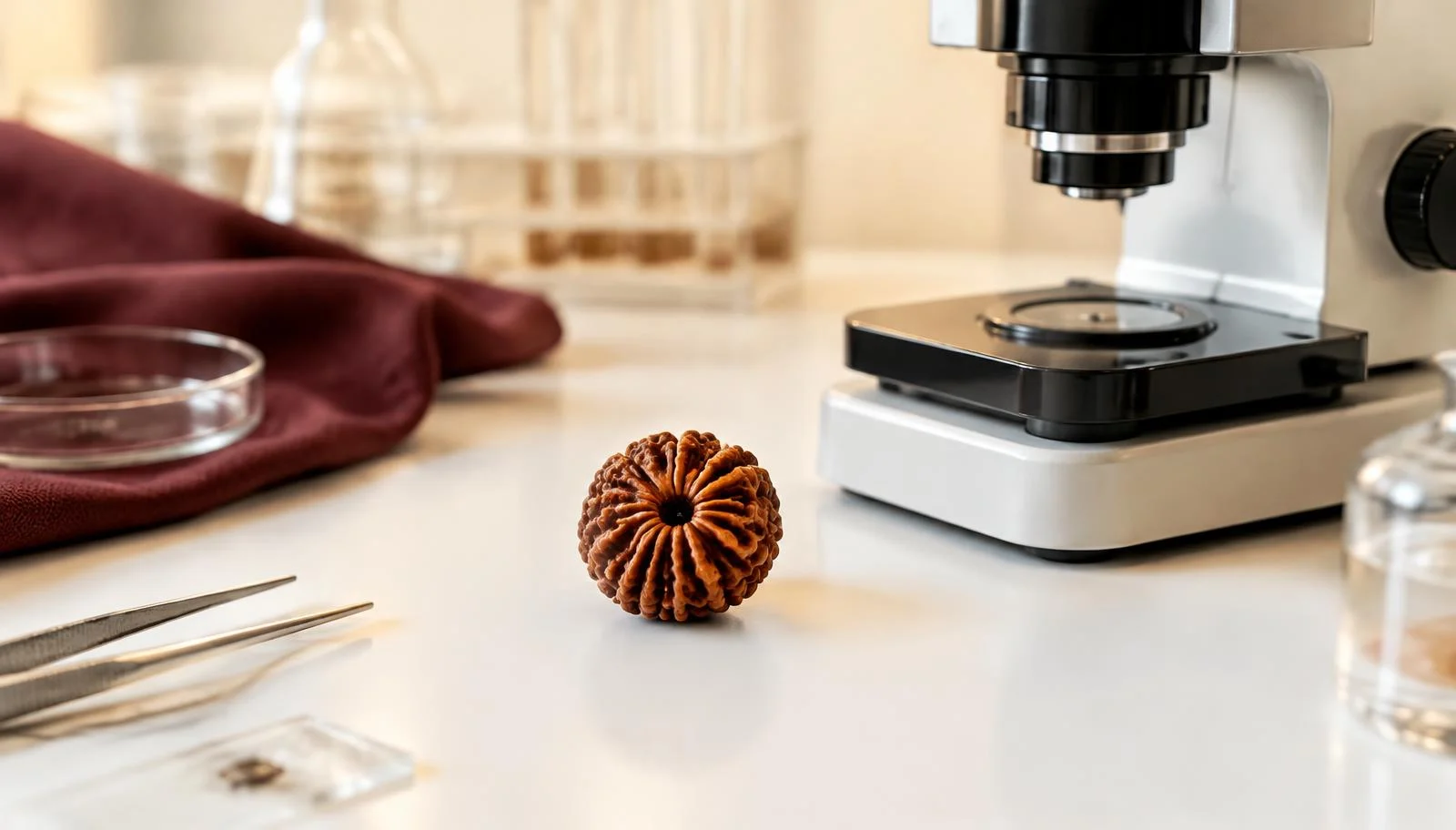
A 2021 paper in AIP Conference Proceedings investigated an Ag/Rudraksha/Ag arrangement, placing a Rudraksha sample between silver electrodes. The authors reported resistance in the megaohm range and used capacitance-frequency measurements to estimate complex relative permittivity. They described dielectric behaviour in that device configuration. This is a specific experimental observation, not evidence that a necklace sends a therapeutic current into its wearer. The electrode arrangement, measuring instruments and applied conditions are essential parts of the result and should not disappear when the study is quoted.
A separate 2018 paper examined powdered Rudraksha bead material and reported electrical measurements alongside mineralogical and biochemical analyses. Powder preparation changes how a sample contacts the apparatus, so its findings cannot simply be transferred to an intact bead hanging on a thread. Such studies may motivate further materials research. They do not establish an identical electrical signature for every bead, a reliable human effect or an electrical ranking in which one Mukhi is clinically superior to another. Independent replication remains important.
Why Readings Can Change
Moisture, temperature, sample dimensions, preparation and contact pressure can influence measurements on natural materials. The position and type of electrodes also matter. A dry bead may not produce the same reading as a soaked bead; measuring powder is different from measuring an intact surface. Without recording these conditions, comparing numbers from different experiments can mislead. A credible report should explain the method, sample count, equipment and uncertainty. A number presented without units or test conditions tells a buyer very little about the material.
Electrical Response Is Not Bioelectric Treatment
The human body uses electrical signals, but this fact alone does not connect Rudraksha with a proven bodily effect. ECG and EEG equipment use defined electrodes and electronic systems to record physiological activity. Skin contact and hydration can affect the interface with those sensors. A bead worn as jewellery is not an equivalent instrument. To claim an effect on blood pressure, heartbeat or neurological function, researchers would need suitable human studies, comparison groups, meaningful outcomes and careful analysis of confounding factors. Material measurements cannot replace that evidence.
Rudraksha is a devotional and personal-use item, not a proven electrical therapy. Do not stop prescribed treatment or delay medical advice because of a bead's advertised properties.
Respecting Tradition Without Overstating Science
A person may find a Rudraksha mala meaningful because it supports a familiar prayer routine, reminds them of their intention or provides a tactile way to count mantras. These experiences deserve respectful language. They do not need to be dressed up as guaranteed electromagnetic correction. Traditional associations should be described as traditional associations, while measurable scientific claims should identify their actual evidence. Choosing a bead for devotion is different from purchasing a treatment, and an honest seller should keep that distinction clear throughout the buying conversation.
Do Copper Coins or Water Prove Authenticity?
Popular demonstrations sometimes show a bead moving between copper coins or sinking in water. Neither observation is a dependable stand-alone authenticity test. Movement can be influenced by contact, friction and how an object is held. Sinking depends on density and condition; imitation materials can sink too. A seller should not use either demonstration as proof of a therapeutic current. Instead, consider the bead's visible structure, possible alterations, identification documentation and what the examiner actually tested. Avoid damaging home experiments involving electricity, heat or chemicals.
What to Check Before Buying
Start with your intended use: a single bead for wearing, a comfortable bracelet or a mala for japa. Compare natural Mukhi lines, condition, size, threading and the photographs of the actual item. Ask which origin and material claims are documented. If certification is mentioned, request details of the issuing laboratory, report number and examination scope. A report about identification or internal structure is not clinical proof. Higher price, larger size or a rare Mukhi should never be treated as automatic evidence of stronger medical benefits.
At Mauhurtika, browse the current Rudraksha collection and compare individual listings rather than relying on generalised scientific promises. Read the Rudraksha certificate guidance to understand documentation, or explore Rudraksha malas for prayer use. For personal selection questions, request a consultation. Ask about the specific bead, available report and wearing comfort before ordering; choose within your budget and treat spiritual significance separately from health expectations.
The Balanced Conclusion
Published exploratory studies report electrical responses in tested Rudraksha samples, including resistance and dielectric-related behaviour. These are limited materials-science findings. They do not demonstrate that every bead generates useful electricity, corrects human bioelectric signals or prevents disease. The sensible position is neither to dismiss devotion nor to turn preliminary measurements into medical promises. Appreciate Rudraksha for its cultural and spiritual meaning, assess product details carefully and look for clear evidence whenever a seller uses scientific terminology.
Research Sources
- Study of electrical properties of Ag/Rudraksha/Ag device, AIP Conference Proceedings (2021) - Bioelectrical and mineralogical properties of Elaeocarpus ganitrus bead (2018) - Skin-electrode contact impedance and hydration, Sensors (2022)
Frequently Asked Questions
Q.Do Rudraksha beads have electrical properties?
Exploratory laboratory studies have reported electrical responses in tested samples. Results depend on methods and conditions; they do not prove benefits from wearing a bead.
Q.Does a laboratory certificate prove health benefits?
No. Identification and structural examination are different from controlled clinical evidence about effects in people.
Q.Can Rudraksha replace medical treatment?
No. Treat it as a devotional or personal-use item and continue healthcare recommended by qualified clinicians.