Rudraksha, Tulsi, Sphatik or Karungali Mala: A Material-First Buying Guide
Compare prayer strands by their disclosed material, feel, bead count and construction—not a promise of guaranteed results.
Choosing a prayer mala is not a contest to find the most powerful material. Rudraksha, Tulsi, Sphatik and Karungali are names you may encounter while shopping, but they describe different kinds of objects and devotional associations. A useful comparison starts with what the beads are made from, how the finished strand feels and what the seller can establish about the item.
This guide focuses on four-material shopping decisions: surface, weight, construction, disclosure and care. It complements our existing Rudraksha versus Tulsi guide, rather than creating another two-material benefits ranking. No material is presented here as a medical treatment, a guaranteed remedy or an automatic route to spiritual results.
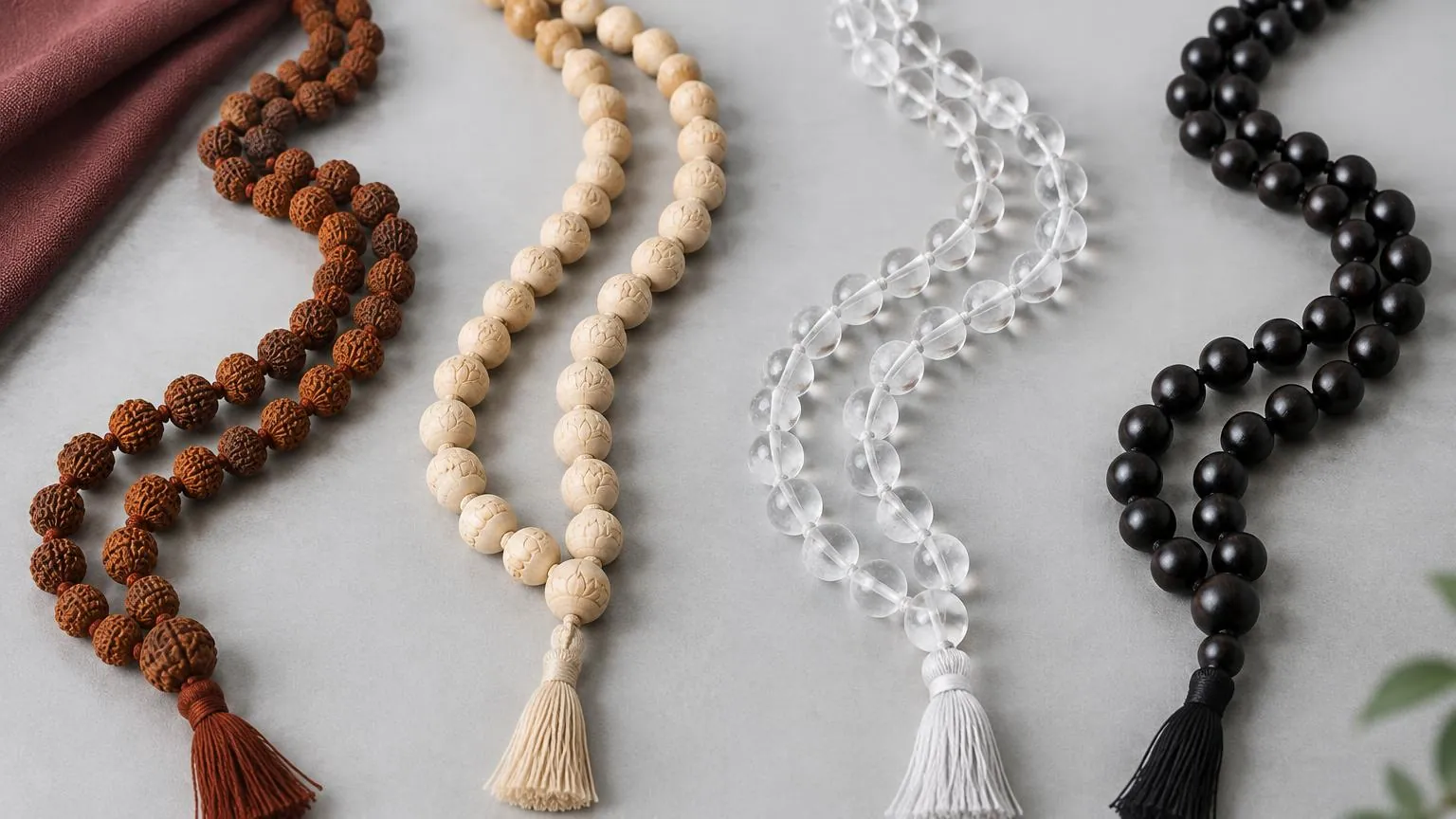
The cover is an illustrative material comparison, not a photograph of four verified Mauhurtika products. Colour and appearance alone cannot establish wood species, quartz identity or Rudraksha authenticity.
Start with the material, not the promise
Rudraksha beads are seeds with a naturally textured surface. Mukhi describes the faces or divisions examined on a bead; it is not the total number of beads in a strand. A mala can use repeated beads of one mukhi or a combination. The listed origin, bead dimensions, number of beads and construction should be checked separately.
Tulsi malas are commonly described as beads made from Tulsi plant wood. Their devotional association is especially familiar in Vishnu and Krishna traditions. That association does not establish the species of a particular wooden bead. Ask the seller what the material description means and whether the strand is intended for wearing or counting japa.
Sphatik usually refers in mala listings to clear quartz crystal. A clear spherical bead is not automatically quartz: glass and other materials can look similar in a photograph. Ask whether the item is natural quartz, treated quartz, glass or another disclosed material. A seller should not rely only on words such as crystal or energised to answer a material question.
Karungali is used in some listings for dark wood, often marketed as ebony. A trade name is not a verified botanical identification. Ask for the stated wood species, any dye, stain or polish, and the seller’s supporting information. Do not assume that every black bead is the same wood or that a dark finish proves natural ebony.
Four materials: practical comparison
| Listing name | Material question | Practical detail to inspect |
|---|---|---|
| Rudraksha | Seed identity, mukhi, disclosed origin and treatment | Surface clefts, drilled holes, bead dimensions and thread clearance |
| Tulsi | What wood is supplied and how is it identified? | Bead finish, smoothness, hole edges and strand flexibility |
| Sphatik | Is the material quartz, glass or something else? | Total weight, chipped edges, drilled holes and contact between beads |
| Karungali | What wood species and surface finish are declared? | Dye or coating disclosure, polish, bead finish and thread condition |
This table is a question list, not an authentication chart. Texture, transparency and colour can help you describe what you see, but an attractive image cannot resolve every material uncertainty. Documentation should relate to the supplied item; an unrelated sample report or a generic brand certificate does not establish every bead in your mala.
Decide whether you want japa, daily wear or a gift
For japa, consider how the beads move through your fingers and whether their size suits your counting rhythm. Raised seed texture, smooth wood and polished crystal feel different. Ask for the bead count, whether a separate guru or meru bead is included, and whether the stated count includes it. Do not assume all strands labelled mala use one count convention.
For daily wear, finished length and total weight matter as much as appearance. A short strand, long necklace and bracelet are not interchangeable. Heavy beads or rigid fittings may be uncomfortable for your routine. Request measurements and, where available, a scale photograph. Choose a fit that does not catch on clothing or require pulling the thread to remove it.
For a gift, ask about the recipient’s existing practice rather than guessing from a benefits list. Their teacher or family tradition may prefer a particular material for a mantra. Material choice, prayer customs and comfort are distinct questions. If you do not know their preference, clear specifications are more useful than a confident promise about results.
What to ask about construction
A strand is more than its beads. Thread, knots, spacers, clasps, pendants and metal fittings can affect comfort and maintenance. Inspect the holes for rough edges, check whether beads rub against sharp fittings, and ask how the strand can be repaired or rethreaded. An elaborate setting does not by itself establish durability or the identity of the material.
- Request the finished length, approximate weight and bead diameter.
- Confirm the count and how the guru bead or accessories are counted.
- Ask whether photographs show your exact strand or a representative example.
- Check disclosed thread, spacer and mounting materials.
- Ask about treatment, coatings and care instructions for the complete assembly.
- Read the actual return conditions before ordering; do not assume repairs or replacements are free.
If you are sensitive to certain metals, ask about every fitting, not only the main pendant. Avoid treating a vague silver-colour or gold-colour description as a statement of precious-metal purity. Where a specific metal claim matters, request the relevant item details before payment.
Caring for mixed-material and single-material malas
Do not use one aggressive cleaning method on all four materials. Wood, seeds, crystal, thread and metal settings can need different handling. Start with the seller’s item-specific instructions. Avoid prolonged soaking, household chemicals, destructive scratch tests or hot-water experiments intended to prove authenticity.
After wear, inspect the thread and store the strand dry, away from unnecessary rubbing and pulling. If there is residue, a new smell, visible cracking or a loose knot, pause before using more cleaning products. Our Rudraksha care guide addresses seed-bead handling; it should not be treated as universal instructions for every wood or crystal product.
For a mixed strand, the most delicate element may determine the safe approach. A bead might tolerate light wiping while its thread, glued fitting or surface finish does not tolerate immersion. Ask which instructions apply to the whole item. Clear, modest guidance is preferable to a guaranteed lifespan that ignores wear and construction.
Why colour, price and rituals do not settle identity
Black does not prove Karungali, transparency does not prove quartz, and a brown textured bead is not authenticated simply by resembling Rudraksha. Low price does not establish a fake; high price does not establish rarity or quality. Compare disclosed materials, dimensions, construction, evidence and order terms together.
Prayers and energisation may matter within your practice, but they are not a laboratory material test. A private report should state its issuer, method, item identification and limitations. Where species or mineral identity matters and seller information leaves uncertainty, consider qualified examination rather than a home demonstration or a universal guarantee.
Explore the right collection without forced buying
For current seed-bead strands, explore the Rudraksha Mala collection. For other currently listed devotional items, browse the Spiritual Store and inspect each product’s own material description. This article does not assert that every material or format is currently stocked, and it intentionally avoids a fixed price list.
If you want help choosing, send your intended use, preferred bead size, length and budget with the product link. Ask Mauhurtika about mala materials and fit. Assistance is an opportunity to clarify the item, not a substitute for evidence or a promise of spiritual results.
Related reading
- Rudraksha versus Tulsi: devotional context
- Understanding Rudraksha colour changes
- How to inspect Rudraksha before buying
- Rudraksha care and storage
Frequently Asked Questions
Q.Which is best: Rudraksha, Tulsi, Sphatik or Karungali mala?
There is no universal winner. Compare your devotional preference, material disclosure, comfort, bead count, construction and care needs. No material guarantees health, wealth or spiritual results.
Q.Is every clear Sphatik bead natural quartz?
No. Appearance alone does not distinguish quartz from glass or other clear materials. Ask for the supplied material and item-specific supporting information.
Q.Does a black bead prove that a mala is Karungali?
No. Dark colour can come from different woods, finishes or treatments. Request the stated species and treatment disclosure rather than relying on a trade name or colour.
Q.Can I clean every mala in the same way?
No. Seeds, wood, crystal, thread and fittings may need different care. Follow instructions for the complete item and avoid soaking, chemicals and destructive home tests.
Q.Should I choose a wearing mala or a japa mala?
Choose by your intended use. For japa, check count and finger comfort; for wearing, check length, weight and fittings. Confirm whether the guru bead is included in the listed count.
Q.Are all four materials available from Mauhurtika now?
Availability changes. Check the current collections and individual product descriptions or enquire with a product link. This guide does not promise stock of every material.