Saraswati Mantras & Puja: Meaning, Chanting & Worship Guide
Goddess Saraswati's symbolism, the main Saraswati mantras with meanings, a home Saraswati Puja Vidhi for Vasant Panchami and calm japa guidance for students, artists and lifelong learners.
Goddess Saraswati is traditionally revered as the deity of knowledge, speech, music and the arts. Her most widely chanted mantra is the beej mantra “Om Aim Saraswatyai Namah”. Her main festival is Vasant Panchami, when students, musicians and teachers place their books and instruments before her for blessings.
Saraswati is perhaps the most approachable of the great goddesses: she asks for no elaborate ritual, only clean intent, quiet attention and respect for learning. This guide covers her symbolism, the principal mantras with their meanings, and a simple puja you can perform at home or in a classroom.
Who Is Goddess Saraswati?
Saraswati appears very early in Indian tradition. In the Rigveda she is praised as a mighty river and as a purifying, inspiring presence; over time she became fully identified with Vak — sacred speech — and with learning itself. In later Puranic tradition she is the consort of Lord Brahma, the creator, and she forms the Tridevi together with Lakshmi and Parvati.
Her name is usually explained as “she who possesses flow” (saras), pointing to the flow of water, words, music and understanding.
Saraswati Symbolism
| Symbol | What it traditionally represents |
|---|---|
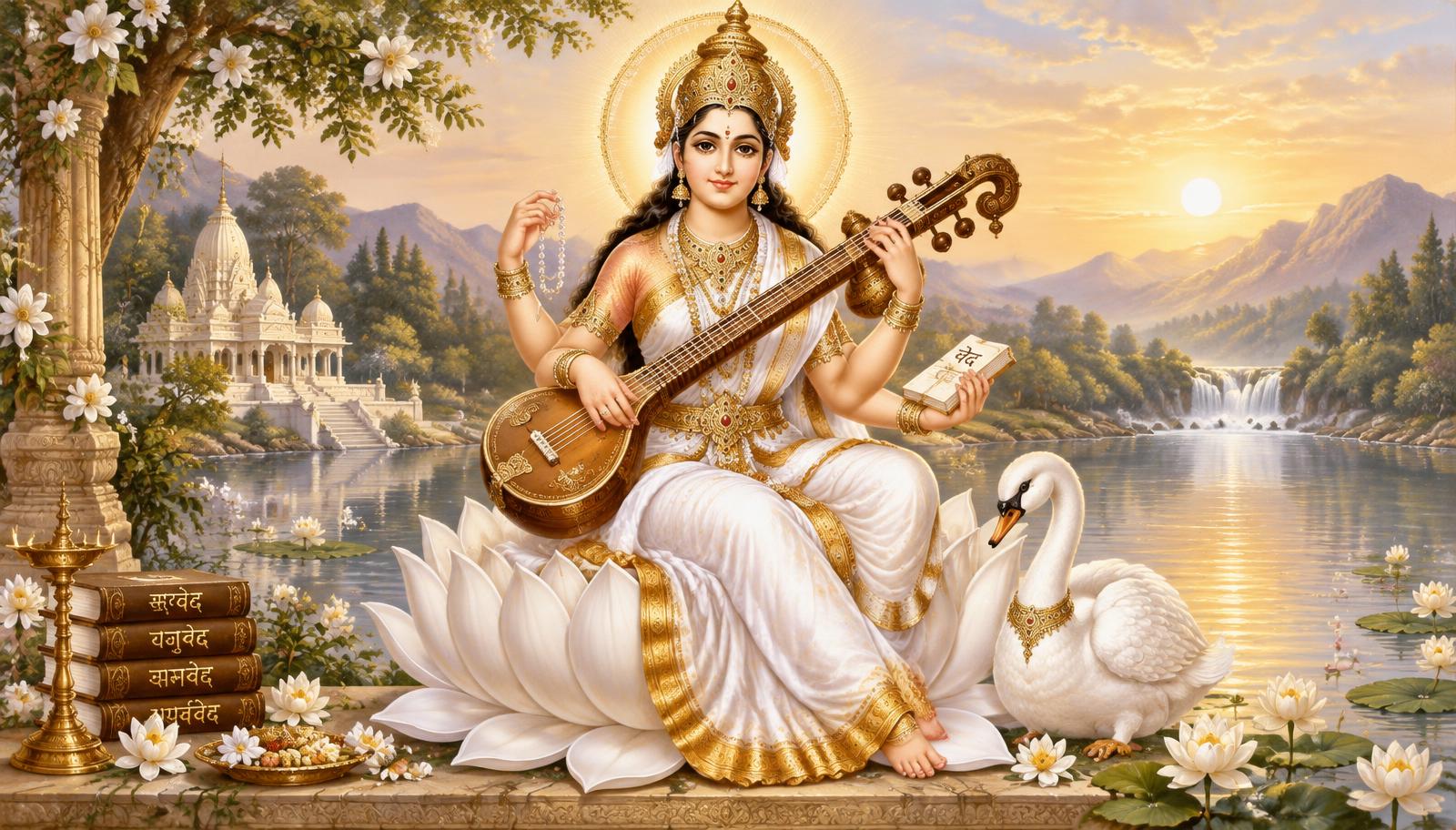
| Veena | Music, harmony and the arts; a mind that is finely tuned |
| Book (pustaka) | The Vedas and all branches of knowledge |
| Mala (akshamala) | Concentration, meditation and repeated practice |
| Swan (hamsa) | Discernment — the legendary ability to separate milk from water, truth from falsehood |
| White clothing | Purity, clarity and sattva (calm balance) |
| Lotus | Knowledge that stays pure in any surroundings |
The veena
She is usually shown playing the veena with two hands. Teachers of classical music often explain that learning, like a stringed instrument, needs both tension and relaxation — neither too slack nor too tight.
The book and the mala
The book stands for knowledge that can be studied; the mala for knowledge that must be practised and repeated until it becomes one's own. Together they describe the two halves of learning.
The swan and the colour white
The swan represents viveka, the power to discriminate wisely. White, her characteristic colour, is linked with clarity of mind. In parts of India she is also shown with a peacock, which is read as the restless ego that knowledge brings under control.
Connection With Knowledge, Music and the Arts
Students write their first letters at her feet (the vidyarambham ceremony in Kerala and Tamil Nadu takes place on Vijayadashami), musicians bow to her before performance, and many schools sing a Saraswati vandana at assembly. Her worship is less about wishing for results and more about cultivating the qualities that make learning possible: humility, patience and attention.
Saraswati Puja and Vasant Panchami
Vasant Panchami falls on the fifth day of the bright fortnight of the month of Magha, usually in late January or February, and marks the arrival of spring. In Bengal, Odisha, Bihar and Assam it is celebrated as Saraswati Puja, with community pandals in schools and colleges. Yellow — the colour of mustard fields in bloom — is worn and used in offerings.
In South India, Saraswati is especially worshipped on the ninth day of Sharad Navratri (Saraswati Puja / Ayudha Puja), when books and tools are placed before the Goddess. The exact date and muhurat change each year, so take them from a panchang for your city.
Saraswati Puja Vidhi
Puja samagri
- White or yellow cloth, and an image or murti of Saraswati
- Books, notebooks, pens, musical instruments or art tools to be blessed
- White and yellow flowers (marigold, jasmine, white lotus if available)
- Chandan (sandalwood paste), haldi, kumkum and akshat
- Ghee lamp, incense
- Bhog: yellow sweets such as kesari bhaat or boondi, fruits (ber or jujube is traditional in Bengal), and milk sweets
- A japa mala — Sphatik and Rudraksha are both used
Simple home puja steps
1. Clean the space and place the image on the cloth, facing east or north if possible.
2. Arrange books and instruments in front of the Goddess. Many families do not study or write on this day until the puja is complete.
3. Light the lamp and incense; offer akshat and invite the Goddess with folded hands.
4. Apply chandan and haldi, then offer flowers, the garland and the bhog.
5. Chant her beej mantra or the Saraswati Vandana and recite the prayer for learning (below).
6. Perform aarti, distribute prasad, and let children write a few letters or mantras to begin the new season of study.
Saraswati Mantras
Saraswati Beej Mantra
ॐ ऐं सरस्वत्यै नमः॥ — Om Aim Saraswatyai Namah
“Aim” (pronounced as in “I’m”) is the seed syllable traditionally associated with Saraswati. The mantra means “Om, salutations to Saraswati”.
Saraswati Gayatri Mantra
ॐ वाग्देव्यै च विद्महे ब्रह्मपत्न्यै च धीमहि। तन्नो वाणी प्रचोदयात्॥ — Om Vagdevyai cha vidmahe, Brahmapatnyai cha dhimahi, tanno Vani prachodayat.
Meaning: “May we know the Goddess of Speech; may we meditate on the consort of Brahma; may Vani inspire and illumine us.” Other Gayatri versions exist in different traditions.
Saraswati Vandana (Ya Kundendu)
या कुन्देन्दुतुषारहारधवला या शुभ्रवस्त्रावृता। या वीणावरदण्डमण्डितकरा या श्वेतपद्मासना॥ — Ya kundendu tushara hara dhavala, ya shubhra vastravrita, ya veena varadanda manditakara, ya shveta padmasana.
This is the opening of a well-loved prayer that describes her as white like jasmine, the moon and snow, clothed in white, holding the veena and seated on a white lotus.
Traditional Prayer for Students
सरस्वति नमस्तुभ्यं वरदे कामरूपिणि। विद्यारम्भं करिष्यामि सिद्धिर्भवतु मे सदा॥ — Saraswati namastubhyam varade kamarupini, vidyarambham karishyami siddhir bhavatu me sada.
Meaning: “Salutations to you, Saraswati, giver of boons who takes any form. As I begin my studies, may I always succeed in them.” Many students recite this before opening their books.
How to Perform Saraswati Mantra Japa
- Time: early morning (Brahma muhurta, roughly 90 minutes before sunrise) is traditionally preferred, but any calm, regular time works.
- Place: a clean, quiet corner; sit on a mat or cloth, not directly on the floor.
- Count: one mala of 108 is common; students often do a short daily practice of 11 or 21 repetitions before study.
- Mala: Sphatik (clear quartz) is traditionally linked with Saraswati, and many people simply use their personal Rudraksha mala. Use one mala only for japa and keep it clean.
- Attention: chant clearly and slowly; let the breath settle before and after.
Rudraksha Traditionally Associated With Learning
Among Rudraksha, the 4 Mukhi bead is traditionally associated with Lord Brahma and with learning, memory and expression, and is often chosen by students and teachers. The 6 Mukhi is associated with Kartikeya and focus. These are traditional associations, not academic guarantees. See our 4 Mukhi Rudraksha guide and 6 Mukhi Rudraksha guide.
Related Reading
- Powerful Shiva mantras for Rudraksha japa
- Maa Shailputri: Navratri Day 1 guide
- Yantra vs mantra vs Rudraksha
Frequently Asked Questions
Q.What is the Saraswati beej mantra?
“Om Aim Saraswatyai Namah”. “Aim” is the seed syllable traditionally associated with Saraswati.
Q.When is Saraswati Puja celebrated?
Mainly on Vasant Panchami, the fifth day of the bright fortnight of Magha (January/February). In South India she is also worshipped on the ninth day of Sharad Navratri.
Q.Why is yellow worn on Vasant Panchami?
Yellow reflects the mustard fields that bloom at the start of spring and is traditionally considered auspicious for the day.
Q.Can chanting a Saraswati mantra guarantee exam success?
No. It is traditionally used to support focus, calm and devotion, but results depend on study and preparation.
Q.Which mala is used for Saraswati japa?
Sphatik is traditionally linked with Saraswati, and Rudraksha malas are also widely used for her mantras.
Q.Should books be kept aside on Saraswati Puja?
Many families place books before the Goddess and avoid studying until the puja is complete, then begin again with a short prayer.