Maa Shailputri Devi: Story, Puja Vidhi, Mantra & Navratri Day 1
Who Maa Shailputri is, why she opens Navratri, the story of Sati's rebirth as the daughter of the Himalaya, and a calm step-by-step Day 1 home puja with mantra and vrat guidance.
Maa Shailputri is the first of the nine forms of Goddess Durga (Navadurga) and is worshipped on Pratipada, the first day of Navratri. Devotees traditionally begin the festival with Ghatasthapana (installing the sacred kalash), then offer her flowers, ghee and a simple bhog while chanting “Om Devi Shailaputryai Namah”.
Navratri opens with a goddess who represents the very start of a journey. Before the fierce warrior forms and before the forms of deep wisdom, devotees greet the Mother as a mountain's daughter — grounded, steady and patient. This guide explains who she is, the story told about her, and how families traditionally worship her at home on Day 1.
Who Is Maa Shailputri?
In the Navadurga tradition, the Goddess is worshipped in nine forms over the nine nights of Navratri. Shailputri is the first. She is understood as a form of Goddess Parvati — the consort of Lord Shiva — in her role as the daughter of Himavan, king of the Himalaya mountains.
Because she comes first, devotees often describe her as the foundation of the whole Navratri sadhana. The common teaching is simple: just as a building needs a firm base, a nine-day spiritual practice begins with steadiness, discipline and faith.
Meaning of the name Shailputri
The name joins two Sanskrit words: Shaila (mountain, rock) and Putri (daughter). Shailputri therefore means “daughter of the mountain”. Related names used in prayers include Parvati (she of the mountain), Haimavati (daughter of Himavan) and Girija (born of the mountain).
Shailputri as the First Form of Navadurga
The nine forms are traditionally listed in the Devi Kavacham, recited as part of the Durga Saptashati. The usual order is:
| Day | Form | Traditional theme |
|---|---|---|
| 1 | Shailputri | Beginning, steadiness, devotion |
| 2 | Brahmacharini | Austerity and discipline |
| 3 | Chandraghanta | Courage and calm |
| 4 | Kushmanda | Creative energy |
| 5 | Skandamata | Motherly care |
| 6 | Katyayani | Righteous strength |
| 7 | Kalaratri | Removal of darkness and fear |
| 8 | Mahagauri | Purity |
| 9 | Siddhidatri | Spiritual accomplishment |
Navratri Day 1 Significance
Day 1 falls on Pratipada, the first lunar day of the bright fortnight in the month of Ashvin (Sharad Navratri) or Chaitra (Chaitra Navratri). Most households perform Ghatasthapana in the morning during a muhurat given by their local panchang, and many sow barley seeds (jau or jawara) in a clay bed beside the kalash. The sprouts that grow over nine days are traditionally seen as a sign of the household's blessings.
Because the muhurat is calculated from local sunrise and the tithi timings, always take it from a panchang for your own city rather than from a national list.
Traditional Iconography
Vahana: the bull
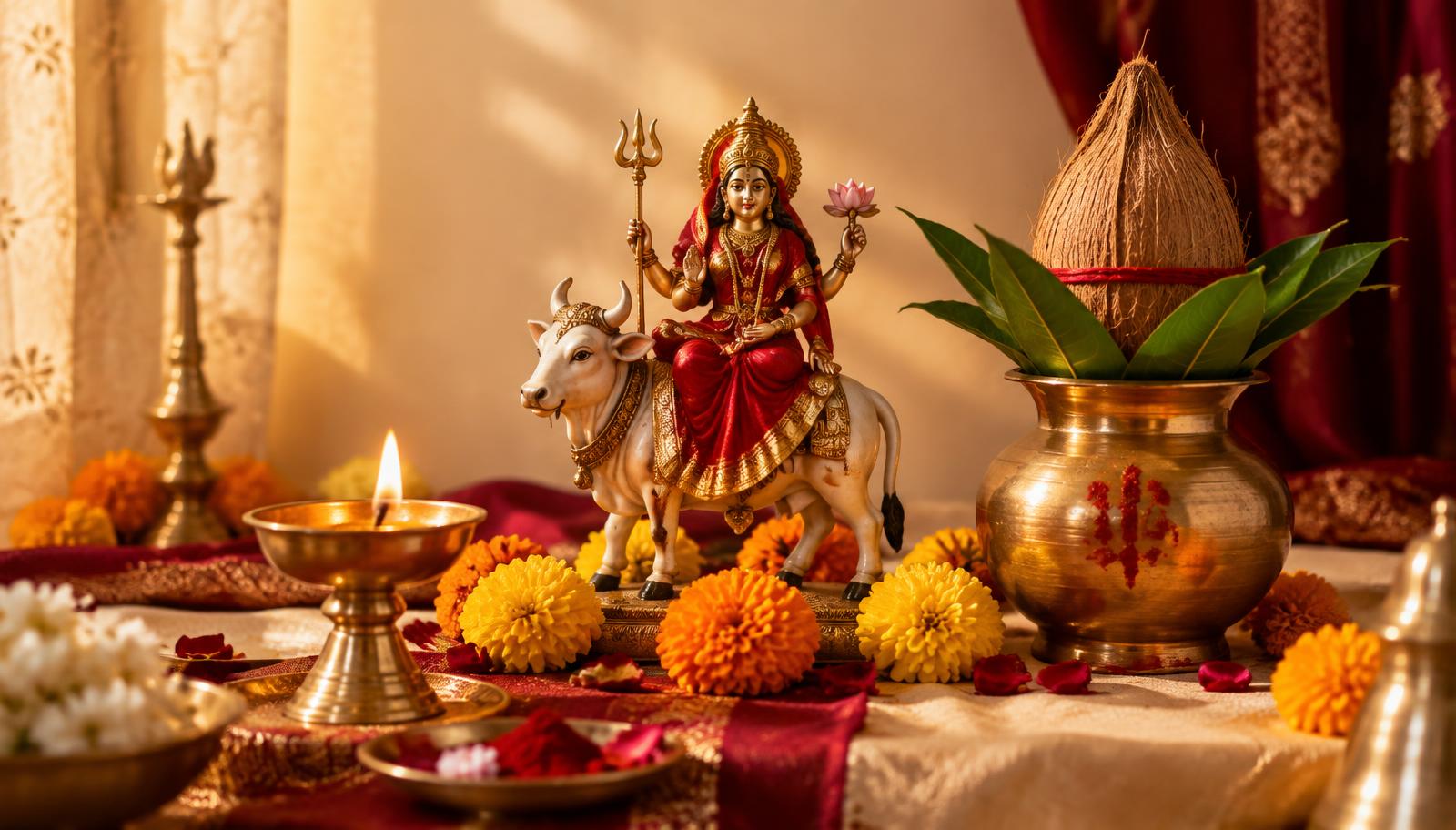
Shailputri is shown riding Nandi, the bull, which is also Lord Shiva's mount. For this reason she is sometimes called Vrisharudha (seated on a bull). The bull is commonly read as a symbol of patience, strength and dharma.
Trishul and lotus
She is usually depicted with two hands: a trishul (trident) in the right and a lotus in the left. A crescent moon often adorns her forehead. Devotional explanations generally link the trishul with the power to overcome negativity and the lotus with purity that rises untouched by its surroundings.
Connection With Goddess Parvati
Shailputri is not a separate goddess from Parvati — she is Parvati remembered at a specific point in her story: as the newly born daughter of the mountain king, destined to reunite with Shiva. Worshipping her on Day 1 is therefore also a quiet remembrance of Shiva and Shakti together, which is why Shiva devotees often begin Navratri with both names on their lips.
The Story of Sati and Shailputri
The story is told in several Puranas with small differences. In its most familiar form, the Goddess was first born as Sati, daughter of King Daksha Prajapati, and married Lord Shiva against her father's wishes. Daksha later held a great yajna and invited every deity except Shiva.
Sati went to the ceremony uninvited. When Daksha insulted Shiva in front of the assembly, she could not bear it and gave up her body in the sacrificial fire. Shiva's grief and anger that followed are central to the traditions of the Shakti Peethas.
The Goddess was then reborn as the daughter of Himavan and Mena in the Himalaya. As Shailputri — and later as Parvati, through deep tapasya — she was reunited with Shiva. Devotees read the story as one of loyalty, self-respect and a love that continues across lifetimes.
Shailputri Devi Katha: how it is read on Day 1
On Navratri's first morning many families read this story aloud after the kalash is installed, often from a Durga Saptashati or a Navratri vrat katha book. There is no single fixed wording; follow the book used in your family or temple.
Navratri Day 1 Puja Vidhi
Puja samagri
- Clean red or yellow cloth and a wooden chowki
- Picture or murti of Maa Durga / Shailputri
- Kalash (copper, brass or clay) with water, mango leaves and a coconut wrapped in red cloth
- Clay bed with soil and barley seeds
- Roli or kumkum, akshat (unbroken rice), moli (sacred thread)
- Fresh flowers, especially red ones, and a garland
- Ghee lamp, incense and camphor
- Bhog — traditionally pure cow ghee, or sweets made with ghee
- A japa mala if you plan to chant (Rudraksha or Sphatik are both commonly used)
Step-by-step home puja
1. Prepare: bathe, wear clean clothes and clean the puja area. Spread the cloth on the chowki.
2. Sankalpa: sit facing east or north, hold water and akshat in your right hand and state your name, the date and your intention to observe Navratri.
3. Ghatasthapana: place the clay bed, sow the barley, set the kalash on or beside it, and crown it with mango leaves and the coconut — within your local muhurat.
4. Invocation: invite the Goddess with folded hands and offer akshat at the picture or murti.
5. Offerings: offer kumkum, flowers, the garland, incense and the lamp in turn.
6. Bhog: offer ghee or a ghee-based sweet. Many families associate ghee specifically with Shailputri.
7. Mantra and katha: chant her mantra, read the katha or the first chapter of Durga Saptashati.
8. Aarti: perform aarti, then distribute prasad.
Traditional Colour of the Day
Colour-wearing for each Navratri day is a newer, regional custom (it is especially popular in Maharashtra). The colour changes every year because it follows the weekday on which Pratipada falls, so there is no fixed “Shailputri colour”. Check the colour list published for the current year if you follow this practice. Separately, red and yellow flowers and cloth are widely used in Day 1 worship.
Planetary and Chakra Associations
Some astrological traditions link Shailputri with the Moon, and many modern yoga teachers connect Day 1 with the Muladhara (root) chakra, matching her theme of a firm foundation. These are later interpretive associations rather than statements found uniformly in classical texts, so treat them as optional meditative aids.
Shailputri Mantra
Primary mantra:
ॐ देवी शैलपुत्र्यै नमः॥ — Om Devi Shailaputryai Namah (Salutations to Goddess Shailaputri)
Dhyana shloka (meditation verse):
वन्दे वाञ्छितलाभाय चन्द्रार्धकृतशेखराम्। वृषारूढां शूलधरां शैलपुत्रीं यशस्विनीम्॥ — Vande vanchhitalabhaya chandrardhakritashekharam, vrisharudham shuladharam shailaputrim yashasvinim.
Meaning: “I bow to the glorious Shailputri, who wears the half-moon on her crown, rides the bull and holds the trident, for the fulfilment of righteous wishes.”
Prarthana / stuti
या देवी सर्वभूतेषु माँ शैलपुत्री रूपेण संस्थिता। नमस्तस्यै नमस्तस्यै नमस्तस्यै नमो नमः॥ — Ya devi sarvabhuteshu Maa Shailaputri rupena samsthita, namastasyai namastasyai namastasyai namo namah.
This follows the pattern of the well-known “Ya Devi Sarvabhuteshu” verses of the Devi Mahatmya, with the form's name inserted.
How Devotees Traditionally Perform Mantra Japa
- Sit on a clean asana after the puja, spine upright, facing east or north.
- Use a 108-bead mala plus the guru (sumeru) bead; move one bead per repetition with the thumb and middle finger, and never cross the guru bead — turn the mala around instead.
- One mala (108 repetitions) is a common daily count; some devotees do 3, 5 or 11 malas.
- Chant slowly and clearly, aloud or under the breath. Consistency across the nine days is valued more than speed.
If you are choosing a mala, our Rudraksha Mala collection lists genuine Rudraksha japa malas, and our guide on how to energise Rudraksha explains the traditional preparation.
Fasting and Vrat Practices
Navratri fasting varies widely by family and region. Common patterns include a single sattvik meal a day, a phalahar (fruit-and-milk) fast, or avoiding grains, onion and garlic for nine days while using vrat foods such as kuttu, singhara, sabudana and rock salt. Some devotees fast only on the first and last days.
Related Reading
- Powerful Shiva mantras for Rudraksha japa
- Rudraksha wearing rules for women
- Saraswati mantras & puja guide
- The complete Rudraksha guide
Frequently Asked Questions
Q.Which day of Navratri is dedicated to Maa Shailputri?
She is worshipped on the first day, Pratipada, of both Sharad and Chaitra Navratri, usually together with Ghatasthapana.
Q.Is Maa Shailputri the same as Goddess Parvati?
Yes. She is Parvati remembered as the daughter of Himavan, after the Goddess's earlier life as Sati.
Q.What bhog is offered to Maa Shailputri?
Pure cow ghee, or sweets prepared in ghee, is the offering most commonly associated with her. Families also offer fruit and simple homemade prasad.
Q.What is the mantra of Maa Shailputri?
The commonly chanted mantra is “Om Devi Shailaputryai Namah”, along with the dhyana verse “Vande vanchhitalabhaya…”.
Q.What colour should I wear on Navratri Day 1?
The popular day-colour list changes each year according to the weekday on which Pratipada falls, so check that year's list. Red and yellow are widely used in Day 1 worship.
Q.Can I wear Rudraksha during Navratri?
Yes. Rudraksha is traditionally worn and used for japa during Navratri by both men and women. Follow the general care and respect guidelines for your bead.