Bulk Rudraksha for Temples & Ashrams: Complete Buying & Procurement Guide
A practical procurement guide for temples, trusts, ashrams and religious organisations planning a bulk Rudraksha order — formats, quantity planning, authenticity checks, origin comparison and a supplier checklist.
Planning a bulk Rudraksha order for a temple, trust or ashram usually comes down to five decisions: how many devotees you are serving, whether you need loose beads or malas, which Mukhi and origin fits the budget, what authenticity documentation you require, and how early you place the order relative to the event date. This guide walks through each decision the way we discuss it with institutional buyers.
Temples, temple trusts, ashrams, spiritual foundations and puja stores buy Rudraksha in very different ways from an individual devotee. An individual chooses one bead for personal sadhana. An institution has to serve a known number of people, work within a sanctioned budget, keep the lot visually consistent, arrange packaging, and receive everything before a fixed religious date. Those constraints change what you should buy and how you should buy it.
This guide is written for that institutional buyer. It covers realistic use cases, which Rudraksha formats are practical at volume, how to estimate quantities, what to verify before committing to a large order, and the questions worth asking any supplier before money changes hands.
Why Temples and Ashrams Buy Rudraksha in Bulk
Larger quantities are almost always driven by a specific programme rather than by inventory speculation. The common requirements we see are:
- Devotee distribution — a single bead or small mala handed to each visitor during a festival, abhishek or special darshan
- Mahashivratri and Sawan programmes — the two periods when Shiva-centred institutions see their heaviest footfall and the largest single orders of the year
- Temple gifting — beads presented to donors, volunteers, priests, patrons or visiting dignitaries
- Spiritual programmes and sadhana camps — japa malas issued to every participant of a retreat, shibir or mantra-diksha programme
- Ashram activities — malas for residents, students and long-term sadhaks, replaced periodically
- Temple shop and counter resale — a stocked counter needs consistent, saleable, well-presented pieces rather than mixed loose lots
- Institutional gifting by trusts and foundations — annual-day, anniversary or charitable distribution
Each of these has a different acceptable price band per unit. A bead given free to five thousand devotees and a mala sold at a temple counter are not the same purchase, and treating them the same is the most common planning mistake.
Which Rudraksha Is Usually Practical for Bulk Requirements?
Not every format scales. Rare high-Mukhi beads exist in limited natural supply and cannot be sourced in hundreds of identical pieces at short notice. For volume requirements, the practical formats are:
Individual Rudraksha beads
Loose beads are the simplest and most economical unit for mass distribution. They are easy to pack, easy to count, and easy to keep visually consistent when purchased as a graded lot. This is the usual choice for large devotee distribution.
5 Mukhi Rudraksha
The 5 Mukhi is the most widely available Mukhi in nature and therefore the most realistic Mukhi for large quantities. It is traditionally associated with Lord Shiva in the form of Kalagni Rudra, is considered suitable for wearing by anyone without specific astrological restriction in most traditions, and is available in consistent sizes and grades. For almost every temple distribution enquiry we receive, 5 Mukhi Rudraksha is the format that fits both supply and budget.
Rudraksha malas
A 108-bead japa mala, a 54-bead half mala or a simple wrist mala is appropriate when the recipient will actually use it for japa — sadhana camps, diksha programmes, ashram residents, priests and volunteers. Malas cost considerably more per unit than a single bead, so quantities are usually smaller and better targeted. Browse the range on our Rudraksha mala page.
Rudraksha pendants
A capped or threaded pendant is a gifting-grade item. It suits donor gifting, felicitation and temple-counter resale rather than mass free distribution, because the metalwork adds meaningful cost per piece.
Ready-to-distribute packs
For events, a bead packed with a simple card or pouch is far easier for volunteers to hand out than loose beads from a tray. Packaging is worth specifying in the order rather than arranging separately at the last moment.
The right answer is a function of quantity, budget per unit and intended use — not of which item sounds most auspicious in a catalogue.
How Many Rudraksha Do You Need?
Estimate from headcount, then add a buffer. Most institutions underestimate footfall on festival days and overestimate how evenly volunteers will distribute. The table below shows the arithmetic for the two most common distribution models.
| Devotees Served | One Bead Per Person | One Mala Per Person | Suggested Buffer |
|---|---|---|---|
| 50 | 50 beads | 50 malas | 5–10% |
| 100 | 100 beads | 100 malas | 10% |
| 250 | 250 beads | 250 malas | 10% |
| 500 | 500 beads | 500 malas | 10–15% |
| 1,000 | 1,000 beads | 1,000 malas | 10–15% |
| 5,000 | 5,000 beads | Usually impractical — beads preferred | 15% |
A few planning notes drawn from real institutional orders:
- Mixed models are common. Many temples give a single bead to every visitor and reserve malas for priests, volunteers, donors and programme participants.
- Buffer for loss and breakage. Threads snap, packets go missing, and volunteers give two to the same family. A 10% buffer is realistic; 15% for very large public events.
- Very large lots need lead time, not just budget. Sourcing, grading and packing five thousand consistent beads is a production exercise, not a same-week dispatch.
- Confirm quantity in writing. Increasing an order mid-production is often harder than placing a slightly larger order at the start.
How to Choose Authentic Rudraksha for a Bulk Order
At volume, authenticity is a process question rather than a single-bead question. These are the checks worth insisting on:
- Origin declared in writing. Nepali and Indonesian (Java) beads differ in size, appearance and price. The origin should appear on the quotation and the invoice, not just in conversation.
- Mukhi identification. The number of natural clefts (mukhi) running from crown to base should be clearly visible and countable on the beads supplied. For a bulk lot, ask how the supplier verifies Mukhi count across the batch.
- Physical condition. Beads should be free of cracks through the vertical axis, unrepaired chips and artificial filling. Surface variation is natural; structural damage is not.
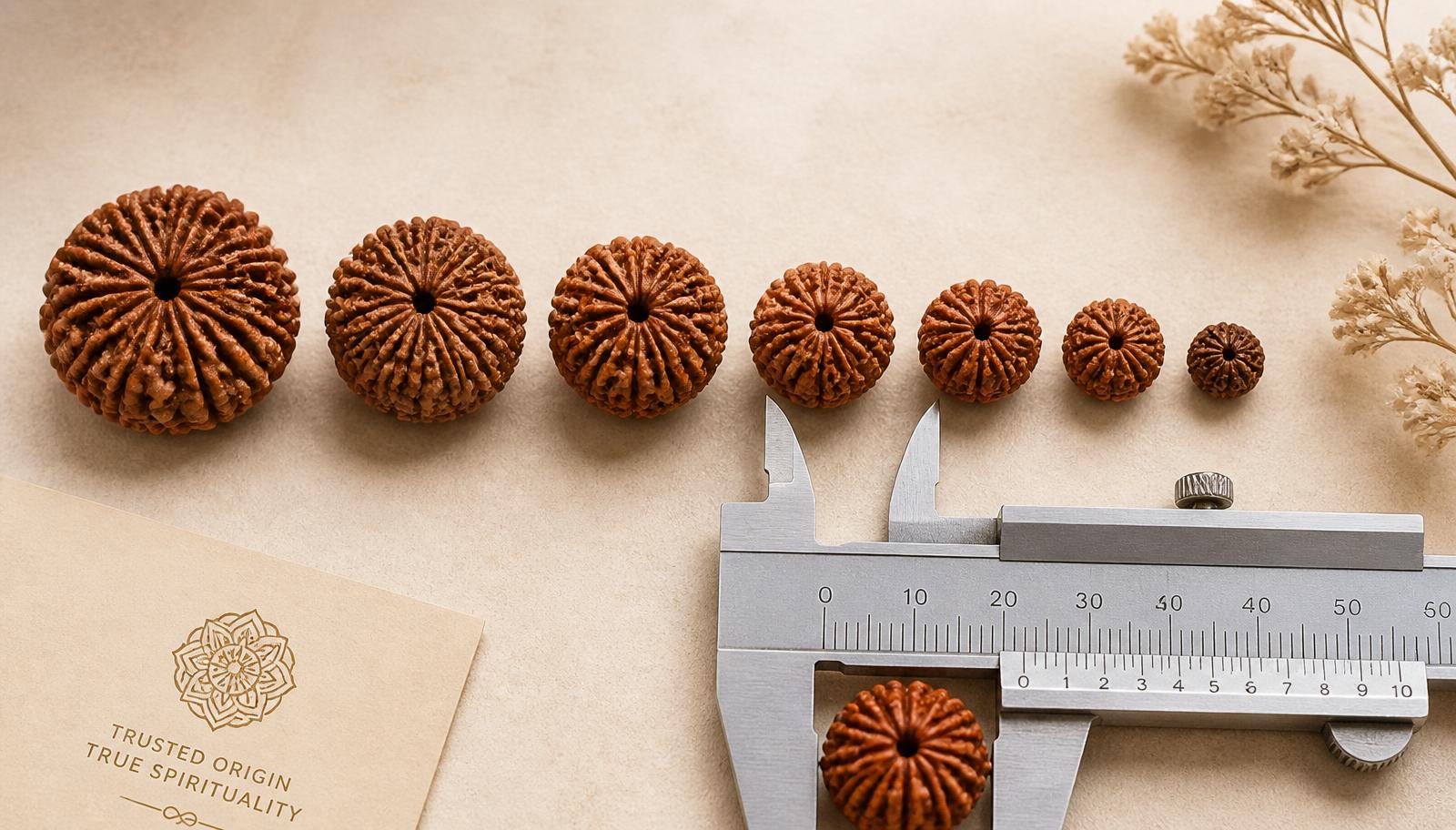
- Consistency of the lot. For distribution, uniformity of size, colour and finish across hundreds of pieces matters more than any single exceptional bead. Ask for the size range in millimetres, not adjectives.
- Clear written specifications. Mukhi, origin, size range, grade, weight, thread or capping details, and packaging should all be stated before payment.
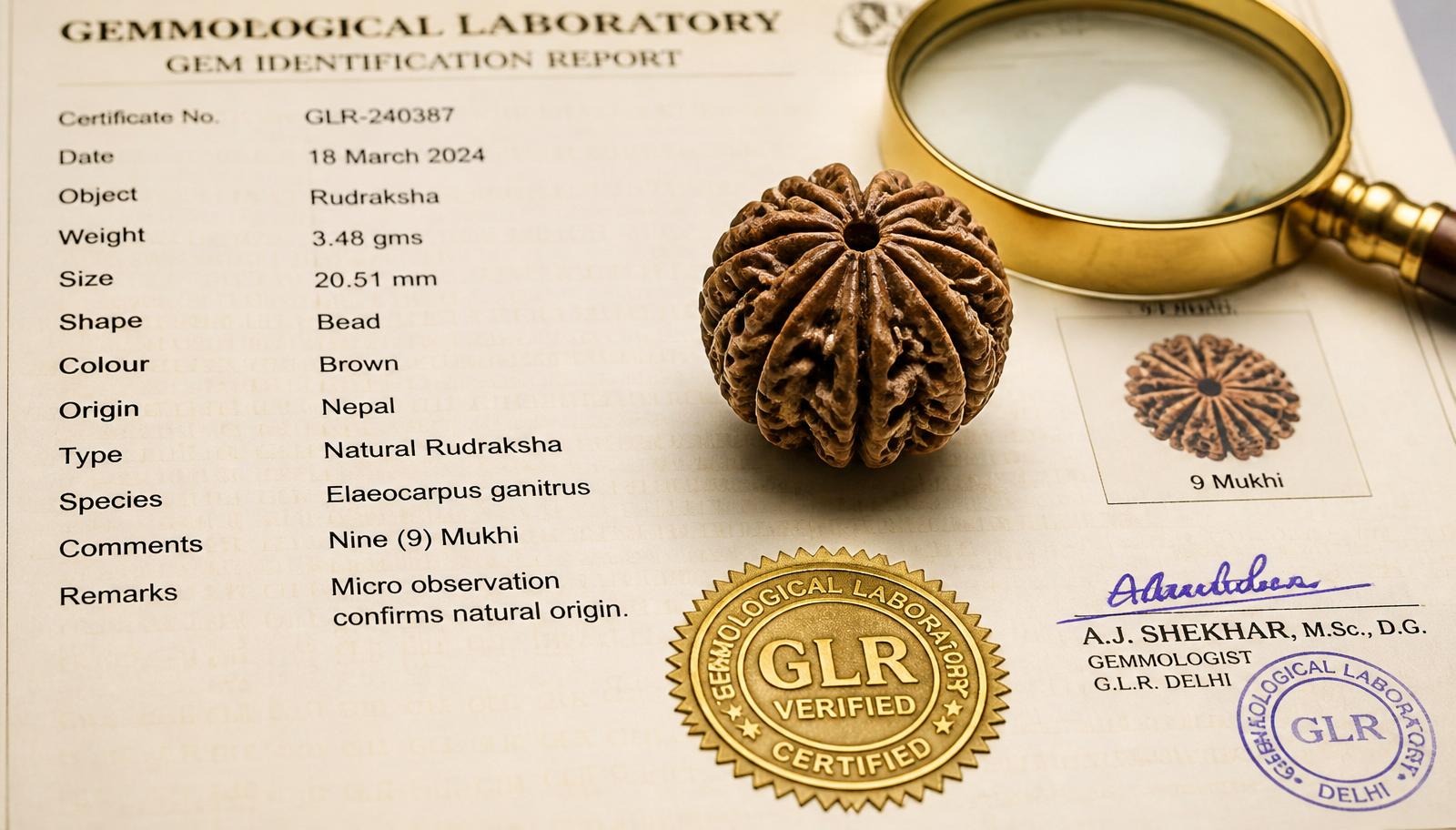
- Certification and testing where applicable. Independent laboratory testing is normally applied to individual higher-value beads and can be arranged for selected pieces in a lot. For a large distribution lot of common beads, per-bead certification is not standard practice — what matters is that the supplier describes honestly what is and is not certified. Our Rudraksha certification and lab testing page explains how the reports work.
- Supplier transparency. A serious supplier will tell you what they cannot do — that a particular Mukhi is not available in your quantity, or that your delivery date is not achievable — rather than accepting every requirement.
- Sample approval before the large order. This is the single most useful safeguard. Approve a small sample set against the written specification, then release the full order against that approved sample.
For background on evaluating beads yourself, see our guides on identifying an original Rudraksha and real versus fake Rudraksha.
Nepali vs Indonesian (Java) Rudraksha for Bulk Orders
Both are genuine Rudraksha from *Elaeocarpus ganitrus*. They differ in the characteristics of the beads, not in legitimacy, and each suits different institutional requirements.
| Aspect | Nepali | Indonesian (Java) |
|---|---|---|
| Typical bead size | Larger, commonly 18–30 mm | Smaller, commonly 6–14 mm |
| Surface appearance | Deeper, more pronounced clefts and heavier grain | Finer, smoother, more even surface |
| Availability at volume | Good for common Mukhi, more limited at large sizes | Widely available, easier for very large lots |
| Cost per bead | Higher for comparable Mukhi | Lower for comparable Mukhi |
| Common institutional fit | Gifting, malas for sadhaks, temple-counter resale | Large-scale free distribution, high-count malas |
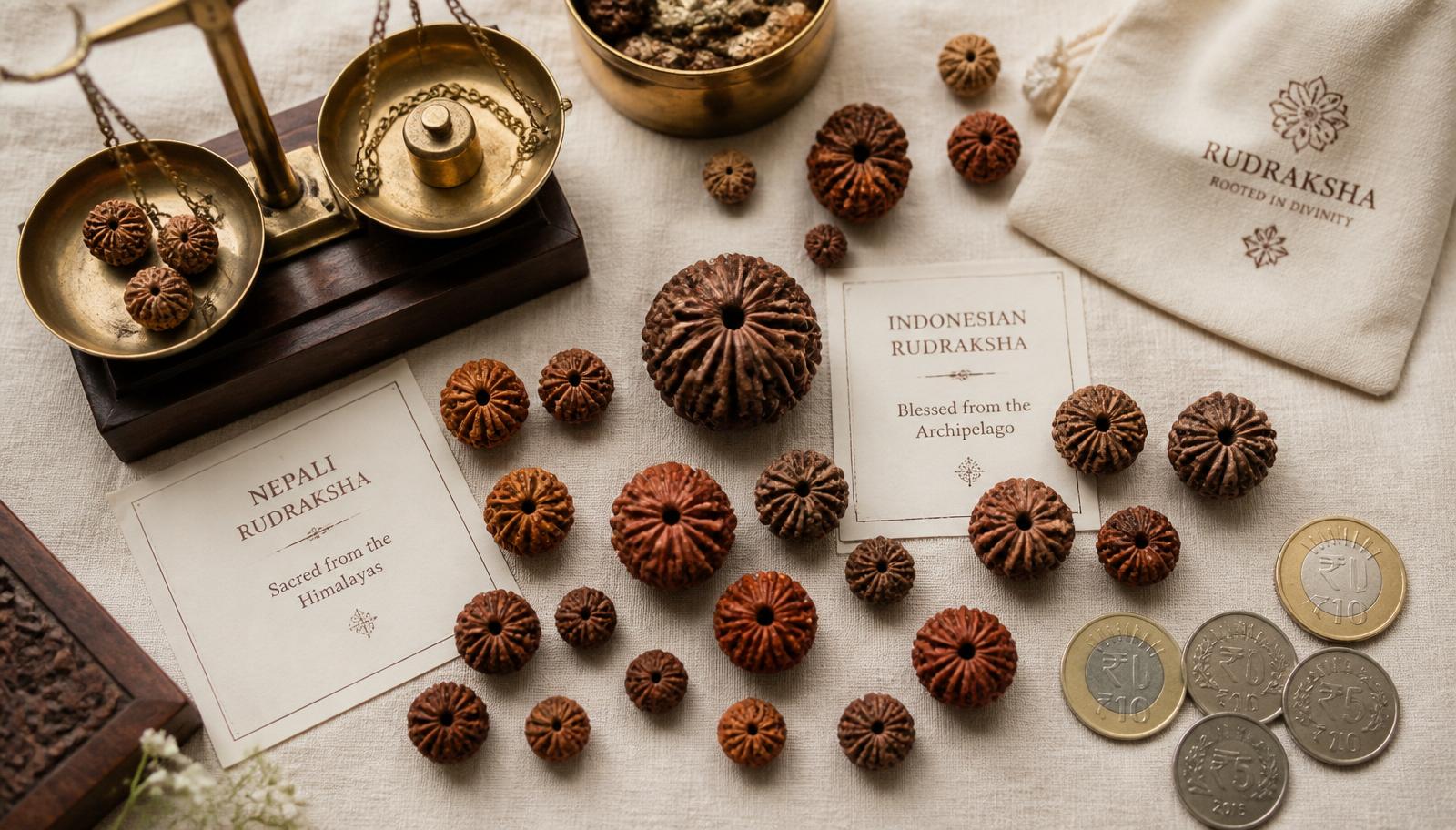
Neither origin is universally superior. Traditional texts do not rank beads by country. A trust distributing to five thousand devotees on a fixed budget will usually find Java beads practical; a trust gifting to a hundred donors may prefer the visual presence of larger Nepali beads. Our 1 to 21 Mukhi Rudraksha guide covers Mukhi selection in more depth.
What Should a Temple Ask a Bulk Supplier Before Ordering?
Use this as a procurement checklist. A supplier who answers all twelve clearly is straightforward to work with; one who avoids several is a risk at volume.
- 1. What Mukhi is being supplied, and is that Mukhi genuinely available in the quantity required?
- 2. Which origin — Nepali or Indonesian (Java) — and will it be stated on the invoice?
- 3. What exact quantity is being quoted, and is the price per unit tied to that quantity?
- 4. Individual beads or malas, and if malas, how many beads per mala and what thread is used?
- 5. What size range in millimetres, and what variation across the lot is acceptable?
- 6. What certification or testing is available, for which items, and at what additional cost?
- 7. Are samples available for approval before the full order is released?
- 8. What packaging options exist — loose in bulk, individual pouches, cards or boxes?
- 9. What is the expected dispatch time from confirmation and payment?
- 10. Where will it ship, and does the quotation include freight to that city?
- 11. What is the replacement or quality policy for damaged or non-conforming pieces on arrival?
- 12. Can a formal bulk quotation with GST details be provided for trust or institutional approval?
Bulk Rudraksha Ordering for Mahashivratri, Sawan & Religious Events
Demand for Rudraksha is strongly seasonal. Mahashivratri and the month of Sawan concentrate a large share of the year's institutional orders into a few weeks, and that affects availability, grading time and courier capacity simultaneously.
Practical planning guidance:
- Fix the headcount estimate and format decision well before the festival month, not during it.
- Request and approve samples early, so production time is spent on your lot rather than on approvals.
- Allow separate time for packing if you need individual pouches or cards — packing several thousand units is a real timeline item.
- Confirm the delivery city and a required-by date at the quotation stage, and account for festival-period courier delays.
- If the programme spans several days, decide whether you want a single consignment or staged deliveries.
There is no artificial deadline here — only the practical reality that large consistent lots take time to source, grade and pack. Earlier planning simply gives you more choice.
Bulk Rudraksha for Temple Distribution vs Temple Resale
These two requirements look similar on a purchase order and are quite different in practice.
| Requirement | Typical Format | Priority | Packaging |
|---|---|---|---|
| Free devotee distribution | Loose beads, commonly 5 Mukhi | Cost per unit, consistency, quantity | Simple pouch or card |
| Temple gifting to donors/volunteers | Larger beads, pendants or malas | Presentation and perceived value | Box or presentation pouch |
| Institutional / programme use | Japa malas | Durability and usability for japa | Functional, protective |
| Temple-shop resale | Malas, pendants, graded beads | Saleability, documentation, margin | Retail-ready with product details |
Resale stock carries an additional obligation: the temple counter becomes the seller, so the product information passed to the devotee must be accurate. Origin, Mukhi and any certification status should be documented for every SKU on the counter, not summarised loosely.
How to Place a Bulk Rudraksha Order with Mauhurtika
Mauhurtika Rudraksha supplies certified beads and malas to individual devotees and to institutional buyers from our Indore base. For a bulk requirement, the fastest route is to send us the specification directly — we respond with availability, honest lead time and a formal quotation.
Please include the following in your enquiry so we can quote accurately in one exchange:
- Required quantity
- Preferred Mukhi
- Origin preference — Nepali, Indonesian (Java) or open to recommendation
- Format — individual beads, malas, pendants or ready-to-distribute packs
- Packaging requirement — bulk, pouch, card or box
- Delivery city
- Required delivery date
- Whether the order is for free distribution, gifting or temple-shop resale
- GST details of the trust, society or organisation, if applicable
Send your bulk requirement on WhatsApp or call +91-9009231652, or write to mauhurtika@gmail.com. You can also use the contact page for a written enquiry, or book a free Rudraksha consultation if you would like guidance on Mukhi selection before finalising quantities. Address: 38, Pumarth Meadows, Manglaya Sadak, Indore 453771, Madhya Pradesh, India.
If you are still comparing suppliers, our guides on Rudraksha wholesalers and distributors in India and choosing an original Rudraksha wholesale supplier set out what to expect from the wider market. To review individual products before deciding on a format, browse the full Rudraksha collection.
Frequently Asked Questions
Frequently Asked Questions
Q.Can I buy Rudraksha in bulk for a temple?
Yes. Temples, temple trusts, ashrams, societies and registered organisations can place bulk orders. Share the quantity, Mukhi, origin preference, format and delivery date, and we issue a formal quotation with GST details for your committee records.
Q.What is the best Rudraksha for bulk distribution?
For large-scale free distribution, the 5 Mukhi Rudraksha is usually the most practical choice — it is the most widely available Mukhi, is traditionally considered suitable for all devotees, and can be supplied as a consistent graded lot at a workable cost per unit.
Q.Can I order 5 Mukhi Rudraksha in bulk?
Yes. The 5 Mukhi is the Mukhi most commonly ordered in bulk, in both Nepali and Indonesian (Java) origin. Availability at very large sizes is more limited, so confirm the size range at the quotation stage.
Q.Can temples order Rudraksha malas in bulk?
Yes. Malas are commonly ordered for priests, volunteers, sadhana camp participants and temple-shop resale. Because the cost per unit is higher than a single bead, mala quantities are usually smaller and more specifically targeted than distribution beads.
Q.How should I verify Rudraksha before placing a large order?
Approve a physical sample against a written specification covering Mukhi, origin, size range, condition and packaging, then release the full order against that approved sample. Also ask what certification is available and for which items.
Q.Can an ashram place a bulk Rudraksha order?
Yes. Ashrams and spiritual organisations regularly order malas for residents and programme participants, and beads for public distribution. The enquiry process is the same as for a temple trust.
Q.How far in advance should I place a large Rudraksha order?
As early as your headcount and budget are confirmed, particularly for Mahashivratri and Sawan when demand and courier load are both at their highest. Sourcing, grading and packing a large consistent lot takes time beyond normal dispatch.
Q.Can I request a bulk quotation?
Yes. Send your quantity, Mukhi, origin preference, format, packaging requirement, delivery city and required date, and we will provide a written quotation including GST details where applicable.
Q.Do bulk Rudraksha beads come with a certificate?
Independent laboratory certification is normally applied to individual higher-value beads and can be arranged for selected pieces within a lot. For large distribution lots of common beads, per-bead certification is not standard practice; we state clearly in the quotation what is certified and what is not.
Q.Can you supply both Nepali and Indonesian Rudraksha in the same order?
Yes, provided each portion is specified separately. Many institutions use Java beads for mass distribution and Nepali beads for gifting within the same programme.