5 Mukhi Rudraksha Mala: Benefits, Uses & Complete Buying Guide
What a 5 Mukhi Rudraksha Mala is, why five-faced beads are the classic mala choice, what 108+1 means, Nepali vs Indonesian beads, how to check authenticity and what really drives the price.
A 5 Mukhi Rudraksha Mala is a string of Rudraksha beads that each carry five natural vertical lines (mukhis). The most common format is 108 beads plus one larger Meru or Guru bead, used for mantra japa, meditation and daily wear. In Hindu tradition the five-faced bead is linked with Lord Shiva in his Kalagni Rudra form. Its benefits are matters of faith and tradition, not scientifically proven effects.
If you have started looking for a Rudraksha mala, you will notice that the five-faced bead appears far more often than any other. That is not an accident of marketing. It is the most naturally abundant Rudraksha, the one most widely recommended in traditional texts for general wearers, and the bead most temple priests and teachers hand to beginners. This guide explains what you are actually buying, how the 108+1 structure works, how to tell a genuine mala from a poor one, and what should — and should not — affect the price you pay.
What Is a 5 Mukhi Rudraksha Mala?
Rudraksha is the dried seed of the *Elaeocarpus ganitrus* tree (the wider genus includes several related species), which grows in the Himalayan foothills of Nepal and India and in parts of Indonesia. When the outer blue fruit is removed, a hard, wrinkled seed remains. The natural grooves that run from top to bottom of that seed are called mukhis, or faces.
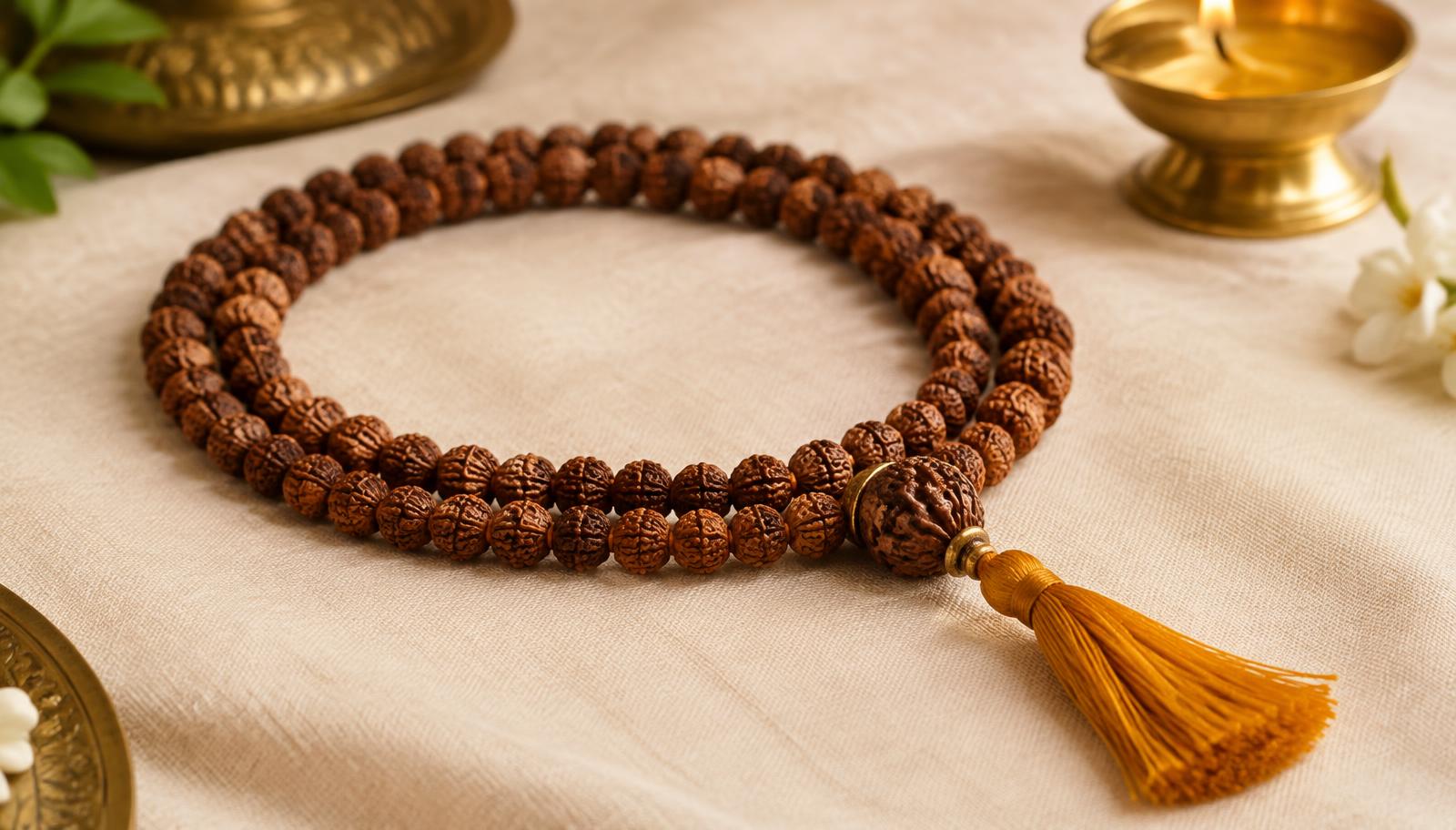
A 5 Mukhi Rudraksha Mala is a necklace-length string made entirely of five-faced beads. Most are strung on silk or cotton thread with a knot between each bead, while some are capped or linked in silver wire for durability. The mala usually ends in a larger bead — the Meru — often with a tassel beneath it.
You will see three broad formats:
- 108+1 japa mala: the classic counting mala, usually with smaller beads (around 5–8 mm) that slide easily through the fingers.
- 54+1 or 27+1 mala: half and quarter lengths, used for shorter practice or worn as a wrist mala.
- Wearable or kantha mala: larger beads (often 10 mm and above), sometimes fewer in number, chosen more for wearing than for counting.
What Does 5 Mukhi Mean?
*Mukhi* comes from the Sanskrit *mukha*, meaning face or mouth. A 5 Mukhi bead has five clearly defined clefts running from its top (where the stalk attached) to its base. Count them by turning the bead slowly and following each line along its full length — a genuine mukhi runs from pole to pole, while a short surface crack does not.
Rudraksha naturally occurs from 1 Mukhi to 21 Mukhi and beyond, but beads with four, five and six faces are the most common. Five faces is by far the most frequent, which is the single biggest reason a full 108-bead mala of this type is affordable while a mala of rarer beads can cost many times more. For a broader overview of each face, see our 5 Mukhi Rudraksha guide.
Traditional Significance of 5 Mukhi Rudraksha
Texts such as the Shiva Purana and the Rudrakshajabala Upanishad describe Rudraksha as born from the tears of Lord Shiva, and they assign each mukhi a presiding deity. The five-faced bead is most often associated with Kalagni Rudra, a form of Shiva, and with the five elements (pancha bhuta) and the five faces of Shiva described in Shaiva tradition — Sadyojata, Vamadeva, Aghora, Tatpurusha and Ishana.
In Jyotish (Vedic astrology), many practitioners link the 5 Mukhi bead with Brihaspati (Jupiter), the planet associated with wisdom, teaching and dharma. Because Jupiter is considered a benefic planet, astrologers often regard the 5 Mukhi as safe for almost anyone to wear, regardless of their birth chart. Different astrologers and lineages hold different views, so treat these as traditional associations rather than fixed rules.
This is also why the five-faced bead is the conventional choice for chanting *Om Namah Shivaya*, the five-syllable (panchakshari) mantra. The five faces and the five syllables are often presented together in devotional teaching.
5 Mukhi Rudraksha Mala Benefits
With that clearly stated, these are the reasons devotees traditionally choose a 5 Mukhi mala:
- Support for a steady practice: many people find that a dedicated mala, used every day, helps them keep a regular japa or meditation routine.
- A sense of calm and focus: devotees often describe a quieter, more settled state during chanting. Any repetitive, attentive practice can feel calming; the mala gives that practice structure.
- Devotion to Lord Shiva: for Shaiva devotees, wearing or chanting with a 5 Mukhi mala is itself an act of remembrance of Shiva.
- Jupiter-related associations: in Jyotish it is traditionally recommended for wisdom, learning and good conduct.
- Suitability for most wearers: tradition considers it gentle and suitable for men, women, students and elders alike.
What it does not do: it does not cure, treat, prevent or control blood pressure, anxiety disorders, heart conditions or any other illness. Claims of guaranteed wealth, success or health from any bead should be treated with caution.
Why Is 5 Mukhi Rudraksha Commonly Used in a Mala?
There are practical and traditional reasons, and they reinforce each other:
- Availability: a 108-bead mala needs 109 well-matched beads of similar size and colour. Only the five-faced variety is plentiful enough to do this consistently at a reasonable cost.
- Uniform shape: five-faced beads are usually round and even, so they sit comfortably in the hand and slide predictably during counting.
- Universal suitability: since tradition treats it as safe for nearly everyone, families often buy one mala that several members can use.
- Mantra alignment: its link with the panchakshari mantra makes it a natural pairing for Shiva japa.
| Feature | 5 Mukhi Mala | Mala of rarer mukhis |
|---|---|---|
| Bead availability | Very common | Limited; harder to match |
| Typical bead uniformity | High | Varies widely |
| Traditional suitability | Considered suitable for most people | Often chosen on specific advice |
| Primary use | Japa, meditation, daily wear | Specific purposes, collector value |
| Relative cost | Accessible | Much higher |
108+1 Beads: What Does It Mean?
The standard full mala has 108 counting beads and one Meru bead. The 108 beads are used to count repetitions of a mantra; the extra bead marks the start and end of the round and is not counted.
Why 108? Several explanations exist, and teachers do not all agree on one. Commonly cited ones include: 12 zodiac signs multiplied by 9 grahas (planets); 27 nakshatras multiplied by the 4 padas (quarters) of each; and the long-standing sacred status of the number in Hindu, Buddhist and Jain traditions. These are explanations offered within the tradition, not historical proofs.
When buying, check that a listing saying “108+1” really means 109 beads in total. Some sellers count the Meru within the 108. Ask before you buy if it is not clear. For a practical walkthrough of how the count works during chanting, read our guide on using a Rudraksha Mala for japa.
5 Mukhi Rudraksha Mala for Japa and Meditation
For japa, smaller beads are easier. A 5–7 mm bead lets the thumb move each one cleanly without fatigue during long sessions. For meditation where you hold the mala without counting, or wear it afterwards, slightly larger beads feel more substantial.
Many practitioners keep two malas: a smaller one reserved purely for chanting, and a larger one for wearing. Traditionally, a mala used for japa is kept somewhat private — not handed around or worn as an accessory — though practices vary between families and gurus.
How to Use a 5 Mukhi Rudraksha Mala
A simple daily approach many people follow:
1. Bathe or wash your hands and feet, and sit in a clean, quiet place.
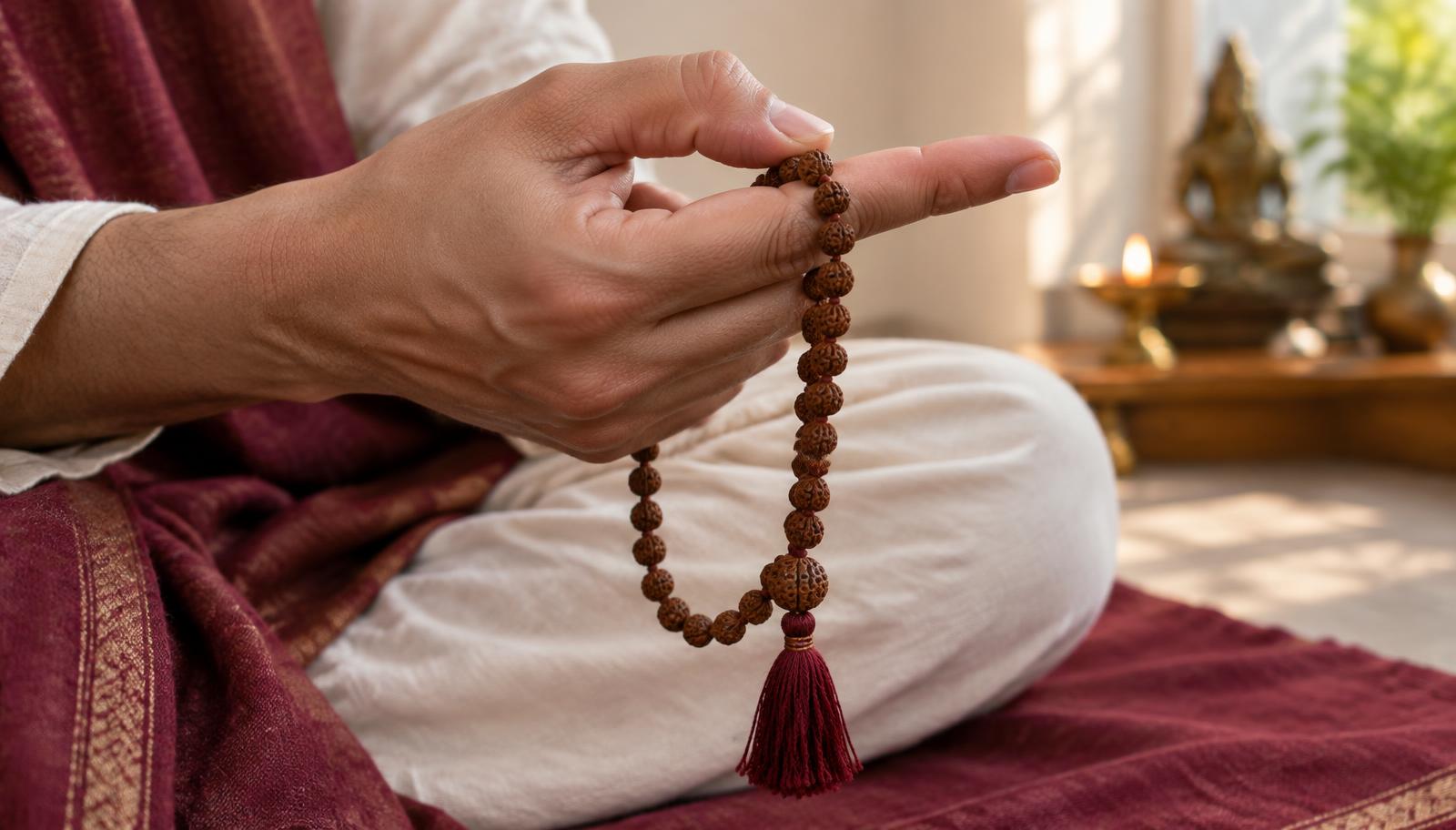
2. Hold the mala in your right hand, draped over the middle finger, beginning at the bead next to the Meru.
3. Move one bead toward you with the thumb for each repetition of your chosen mantra.
4. Complete 108 repetitions until you reach the Meru again.
5. If continuing, turn the mala around rather than crossing the Meru (a common tradition, though not universal).
The full step-by-step method — including posture, finger placement, counting multiple rounds and what to do if you lose count — is covered in our dedicated Rudraksha Mala for chanting guide, so we will not repeat it here.
How to Wear or Carry a 5 Mukhi Mala
- Around the neck: the most common way. Choose a length that lets the beads rest near the heart.
- Wrapped on the wrist: a 108-bead mala of small beads can be wrapped several times; a 54+1 or 27+1 mala sits more comfortably.
- In a pouch: many keep their japa mala in a cotton or silk pouch and wear a separate mala or bracelet day to day.
Common traditional guidance includes removing the mala before sleeping, bathing with soap, visiting a cremation ground or consuming alcohol. Families and gurus differ on these points; our Rudraksha wearing rules guide sets out the main views without claiming any single one is mandatory.
Nepali vs Indonesian 5 Mukhi Rudraksha Mala
Both are genuine Rudraksha. The difference is mainly size, texture and price.
| Aspect | Nepali 5 Mukhi | Indonesian (Java) 5 Mukhi |
|---|---|---|
| Bead size | Usually larger (often 15 mm+ as single beads; smaller beads selected for malas) | Usually small (around 5–9 mm) |
| Surface | Deep, well-defined grooves and pronounced ridges | Smoother, finer grooves |
| Weight | Heavier per bead | Lighter |
| Japa comfort | Good with small, selected beads | Very comfortable for long sessions |
| Typical cost for a full mala | Higher | Lower |
Tradition does not rank one origin as more spiritually valid than the other; preference is personal. Many devotees prefer Nepali beads for their prominent mukhis, while others prefer the light, even feel of an Indonesian japa mala. Our Rudraksha Mala collection lists the origin of every mala so you can compare.
How to Identify an Authentic 5 Mukhi Rudraksha Mala
There is no single home test that proves authenticity. Popular tricks — floating in water, spinning between coins, sinking in milk — are unreliable and should not be trusted. A sensible checklist:
- Natural mukhi lines: every line should run from the top to the bottom of the bead, without signs of carving or filling.
- Consistent but not identical beads: real seeds vary slightly. Perfectly identical beads, a plastic sheen or visible moulding seams are warning signs.
- Natural hole: a genuine Rudraksha has a natural channel through its centre. Look for signs of a drilled hole that is off-centre or that cuts across the internal structure.
- No artificial colouring: heavy dye can rub off on a white cloth. Some oiling is normal; strong colour transfer is not.
- Lab report from an independent gemological or Rudraksha testing lab: X-ray or CT imaging can show the internal compartments (seed chambers) that match the external mukhis. For a full mala, ask whether the certificate covers the whole mala or only sample beads.
- Clear seller information: origin, bead size, bead count, stringing material and a return policy should be stated upfront.
For a deeper explanation, read our original Rudraksha identification guide and certified vs non-certified Rudraksha.
What Affects 5 Mukhi Rudraksha Mala Price?
Two malas that both say “5 Mukhi, 108+1” can differ several times in price. These are the factors that legitimately cause that difference:
| Factor | Effect on price |
|---|---|
| Origin (Nepal vs Indonesia) | Nepali malas generally cost more |
| Bead size | Larger matched beads cost more |
| Uniformity and grading | Well-matched size, colour and clear mukhis raise the price |
| Stringing | Silver capping or silver wire adds metal and labour cost |
| Certification | Independent lab testing adds cost but adds confidence |
| Bead count | 108+1 costs more than 54+1 or 27+1 |
Things that should *not* justify a premium: vague claims of “super-energised” or “siddha” status without explanation, or promises of specific results. A very low price for a large Nepali mala is also worth questioning. Our Rudraksha price guide gives current market ranges.
How to Choose the Right 5 Mukhi Mala
Ask yourself four questions before buying:
- Will I chant with it, wear it, or both? Chanting favours small beads; wearing allows larger ones.
- How long are my sessions? For long daily japa, lighter Indonesian beads may be more comfortable.
- Do I prefer thread or metal? Thread is traditional and quiet; silver-capped malas last longer when worn daily.
- Do I need certification? For a significant purchase, an independent lab report is worth having.
When you are ready, you can explore Rudraksha Mala options filtered by origin, bead count and Mukhi.
Care and Maintenance
- Keep the mala dry. Remove it before swimming or bathing with soap.
- Clean occasionally with a soft, dry brush to remove dust from the grooves.
- A light application of natural oil (many use sandalwood or mustard oil) every few months helps prevent the beads from drying out. Wipe off any excess.
- Store it in a cotton or silk pouch, away from perfumes and chemicals.
- Check the thread every few months; silk thread typically needs restringing after a period of regular use.
Our Rudraksha cleaning and storage guide covers this in more detail.
Frequently Asked Questions
Conclusion
A 5 Mukhi Rudraksha Mala is the most traditional, widely available and broadly suitable Rudraksha mala you can choose. Decide first how you will use it — chanting, wearing or both — and let that guide your choice of bead size, origin and stringing. Check authenticity sensibly, expect to pay for genuine quality and certification, and treat its benefits as a matter of faith and practice rather than guaranteed outcomes. Used regularly with a sincere practice, it becomes a lasting companion for japa and meditation.
Frequently Asked Questions
Q.Who can wear a 5 Mukhi Rudraksha Mala?
Traditionally it is considered suitable for almost everyone — men, women, students and elders. Some families or gurus may have their own guidance.
Q.How many beads are in a 5 Mukhi Rudraksha Mala?
The standard japa format has 108 counting beads plus one Meru bead (108+1). Shorter 54+1 and 27+1 versions are also common.
Q.Is a Nepali or Indonesian 5 Mukhi mala better?
Neither is traditionally considered more valid. Nepali beads are larger with deeper grooves; Indonesian beads are smaller, lighter and often easier for long japa.
Q.Can a 5 Mukhi Rudraksha Mala cure health problems?
No. Its benefits are traditional and spiritual beliefs. It does not treat, cure or prevent any disease and is not a substitute for medical care.
Q.Can I wear my japa mala every day?
Some people do. Others keep a separate mala only for chanting. Both practices are followed; choose what your tradition or teacher recommends.
Q.How do I know if a 5 Mukhi mala is original?
Check for natural pole-to-pole mukhi lines, natural holes and slight bead variation, and ask for an independent lab report. Home tests like floating in water are unreliable.