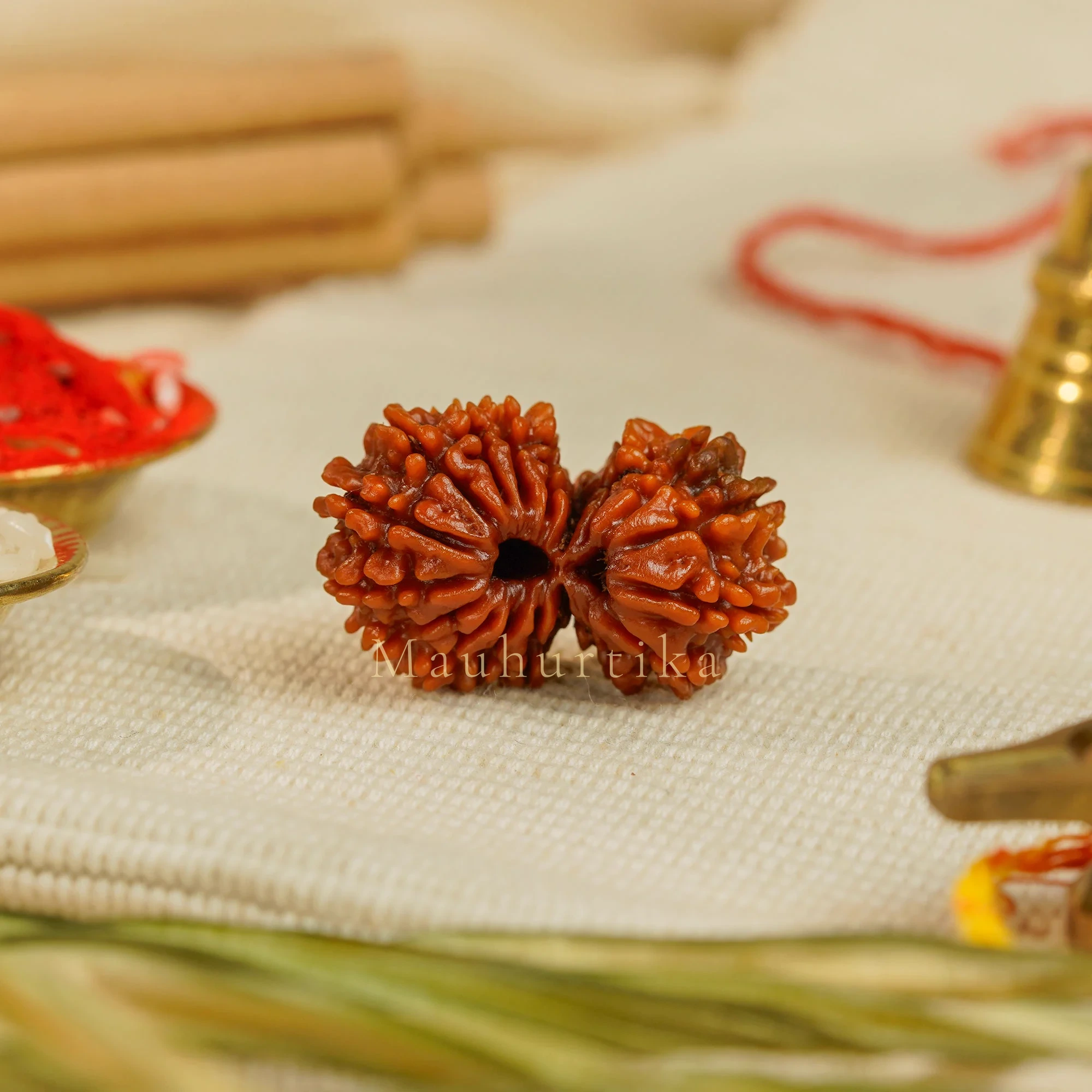

14 Mukhi Gauri Shankar: Count & Buying Questions
14 Mukhi Gauri Shankar explained: combined-count labels, the count on each half, single-bead differences and verification questions before buying.
“14 Mukhi Gauri Shankar” is a market description that needs clarification before it is used as a product specification. A Gauri Shankar is a naturally joined formation with two lobes, each of which has its own visible divisions. The number fourteen may refer to a seller's combined count rather than fourteen on each half. Do not assume that a combined count is the same as a single 14 Mukhi bead.
Start with two separate counts
Ask the seller to state the count attributed to the first half and the second half, and explain how the label was derived. As an arithmetic illustration, seven plus seven equals fourteen; this is not a claim that every bead sold under this name has a 7+7 structure. Other descriptions may use a different convention. Without a stated convention, the product title remains ambiguous.
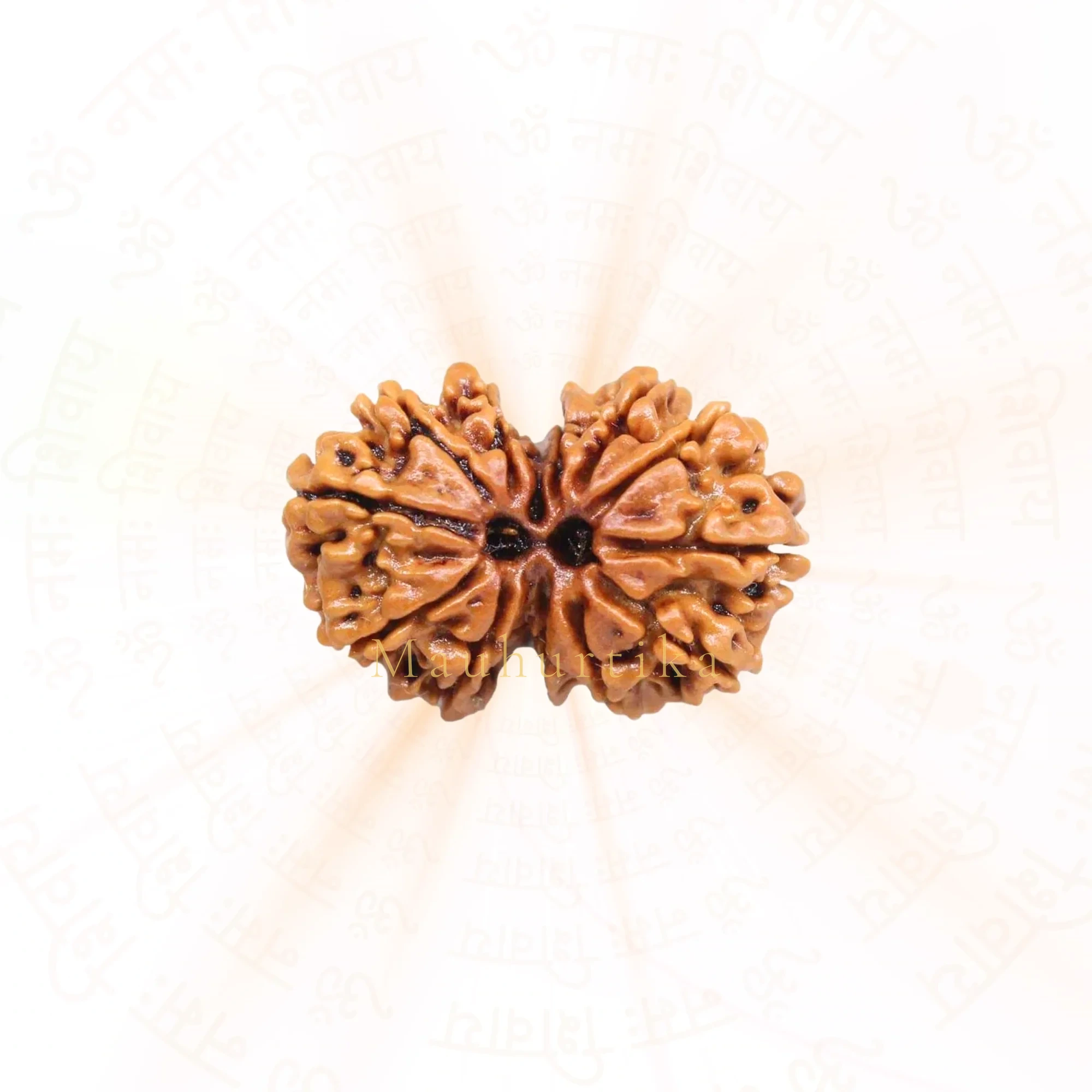
A reliable description should distinguish a visible observation, the seller's interpretation and a finding on any supplied report. These are not interchangeable. Where divisions meet the natural junction, counting from a photograph may be difficult. Request additional views instead of resolving uncertainty by choosing the most impressive number.
Single 14 Mukhi versus joined bead
A single 14 Mukhi Rudraksha is described by fourteen divisions around one bead. A joined Gauri Shankar with a combined count of fourteen is a different formation. Neither should silently substitute for the other in an order. The distinction matters to collectors, to people following a teacher's recommendation and to anyone comparing prices across listings.
If someone has recommended “14 Mukhi,” ask whether they meant a single bead or a named Gauri Shankar variation. Write the answer into your enquiry. This simple clarification can prevent a high-value purchase based on different understandings of the same words.
Shiva and Shakti symbolism
Gauri Shankar is commonly interpreted as a symbol of Shiva and Parvati or Shiva and Shakti together. Some devotees choose it for prayer centred on harmony and mutual understanding. This is cultural and spiritual meaning, not evidence that a bead fixes a relationship or changes another person's behaviour.
Do not automatically transfer every association of a single 14 Mukhi bead onto a joined bead simply because the numbers add up. Ask which tradition supports an interpretation. Religious meanings can coexist without being reduced to a numerical formula or a guarantee of results.
What the photographs should show
- The entire joined formation, not just its most attractive face.
- The junction from multiple angles without a mount concealing it.
- Both poles and a rotating view for following the divisions.
- A size reference and a clear statement of whether the image shows the supplied bead.
- Any damage, repair, resin or surface finish disclosed by the seller.
Photographs are useful for evaluating visible condition; they are not conclusive proof of natural joining. Artificially joined beads may look convincing online. Ask what further examination is available and whether a report distinguishes natural structure from an assembled specimen. Do not accept floating or coin tests as a substitute.
Buying without a matching confirmed listing
At this editorial check, the catalogue did not supply a separately verified half-by-half 14 Mukhi Gauri Shankar specification. This guide therefore does not label a general Gauri Shankar product as a confirmed fourteen-count specimen. That absence is better than presenting an invented match.
You can explore the general Gauri Shankar guide and ask Mauhurtika whether a current specimen has documented individual counts. Specify your desired formation, dimensions and documentation. Do not pay for an exact designation until the order description supports it.
Wearing, mounting and care
Joined beads have an uneven outline, so mounting should avoid pressure on the junction. Ask whether the fitting can be removed for inspection and whether the thread sits comfortably. Repeated wetting, pulling the halves apart or aggressive brushing can damage a bead; none is an appropriate authenticity experiment.
Follow the care instructions for the specific specimen. If using it devotionally, the wearing-day guide explains common customs without imposing a universal rule. Religious use can be respectful and simple while the physical product description remains precise.
Related guides
Read 18 Mukhi Gauri Shankar naming, Gauri Shankar identification and Siddha Mala composition.
Frequently Asked Questions
Q.Does 14 Mukhi Gauri Shankar mean fourteen on each half?
Not necessarily. Ask for the separate count of each half and the seller's counting convention. A total-count label is not proof of fourteen divisions on each lobe.
Q.Is 7+7 always the composition?
No. Seven plus seven is only an arithmetic example. The actual specimen must be described and checked individually.
Q.Can a single 14 Mukhi replace it?
They are different formations. Clarify what your teacher or original enquiry intended before accepting a substitution.
Q.Why are there no exact-match product cards here?
No current half-by-half verified fourteen-count match was established during the editorial check. A general Gauri Shankar listing should not be relabelled to fill that gap.